Metered in credits and minutes, never in our cost.
Two meters, both yours to see. Voice minutes, because that is the unit you already budget in and the one carriers bill. Credits, a single currency covering every other metered activity.
What each activity costs in credits is set by the publisher of the worker pack and ships inside the pack itself. What a credit costs in money is set by whoever sells you the deployment. That separation is deliberate: it is what lets a white label, a marketplace listing and a Corvair-operated tenant price differently without anyone forking the engine.
Because the schedule ships in the pack and versions with it, your rate cannot move underneath you. A repricing arrives as an upgrade you approve, itemised against your current schedule, rather than as a change of terms you discover in an invoice.
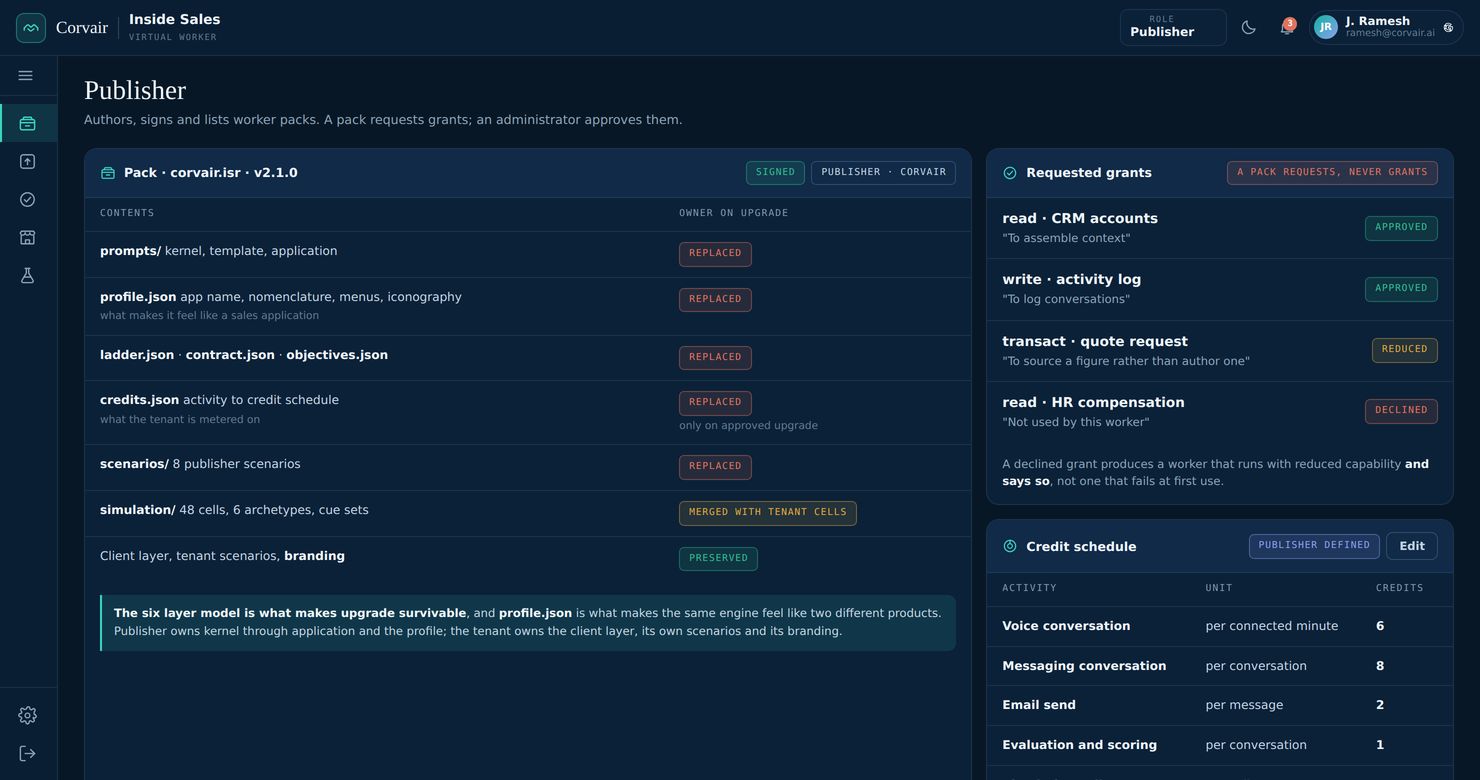
The schedule is a design instrument, not just a price list. In the property pack an enquiry callback is priced below a general conversation, deliberately, because speed of first callback is the metric that moves performance most and the schedule should not discourage the ten-minute callback. An appraisal lead call is priced the same way, because winning the instruction is the most valuable outcome the agency produces.
The three ceilings behave differently, and the differences matter more than the numbers. Minutes exhausted: conversations in progress finish, no new outbound dial, and text channels continue if credits remain. In property, inbound enquiry callbacks are the last thing to stop, because an unanswered enquiry is a lost viewing. Credits exhausted: discretionary consumption stops first, being simulation, research refreshes, enrichment and match runs, while scheduled work is honoured and the queue holds rather than drops. Licence ceiling: a further worker cannot be deployed, existing workers are unaffected, and the ceiling is visible before provisioning rather than after.
What you never see on your invoice is our cost of goods. Model tokens and audio seconds are our problem, and a platform that shows you its margin instead of your bill has confused two different products.
Entitlement suspends; it does not degrade. A worker at zero credits stops and says so. A worker that quietly gets worse as the balance falls is the least debuggable failure we could ship you.
The unit is a worker pack.
A worker definition is data, not code. A worker pack is that data made portable, versioned and signed, and it is what ships in every model below.
What is in a pack
The worker definition, the template and application prompt layers, the agent template and voice mappings, ladders, flows, guardrails, the outcome contract schema, the scoring rubric, the skill and tool manifests, the knowledge scope declaration, the connector requirements and the entitlement shape.
What is never in one
The kernel prompt layer, which is engine code and is what makes every worker in the family behave like one. And customer data, in any form, ever.
| Deployment mode | What ships | Whose brand | Who operates it | Who is accountable for compliance |
|---|---|---|---|---|
| Direct | A tenancy on the Corvair platform | Corvair | You | You |
| Corvair operated | A configured worker we run on your behalf | Either | Corvair | You, with Corvair as processor, stated in the contract |
| White label | The engine in your own cloud project, under your brand | Yours | You | The distributor |
| Embedded | A single worker pack running inside your product | Your product | You | The distributor, unless the host passed it on in writing |
| Marketplace | Packs, bundled with domain content, data or API entitlements | Publisher branded in a catalogue | Whoever installs | The tenant |
Not a roadmap in order. Five shapes the same engine has to fit. White label turns brand into configuration and needs a stated version support boundary, because a partner runs a version rather than the current one. Embedded workers frequently use the host product's own interface as their channel, which costs nothing architecturally because a channel is an adapter. A marketplace sells certification, not packs: schema and guardrail conformance, the pack's own evaluation suite executed with published results, a compliance review of its declared purpose and data classes, and an authority profile checked for proportionality. A lead qualification worker requesting compensation data does not pass.