A conversation ends. Something has to happen next, and in most systems that something is a note in a field nobody reads. Here it is a structured plan, produced from the outcome contract, sized in minutes, and approved before it becomes work.
A backlog you cannot size is a promise you cannot keep.
When a conversation closes and is scored, the worker produces a plan: the specific next actions, each naming the goal it serves and the contract field that produced it. Derived from the structured contract, never from the transcript, because a plan generated from free text is unreviewable, unrepeatable, and drifts as the model changes.
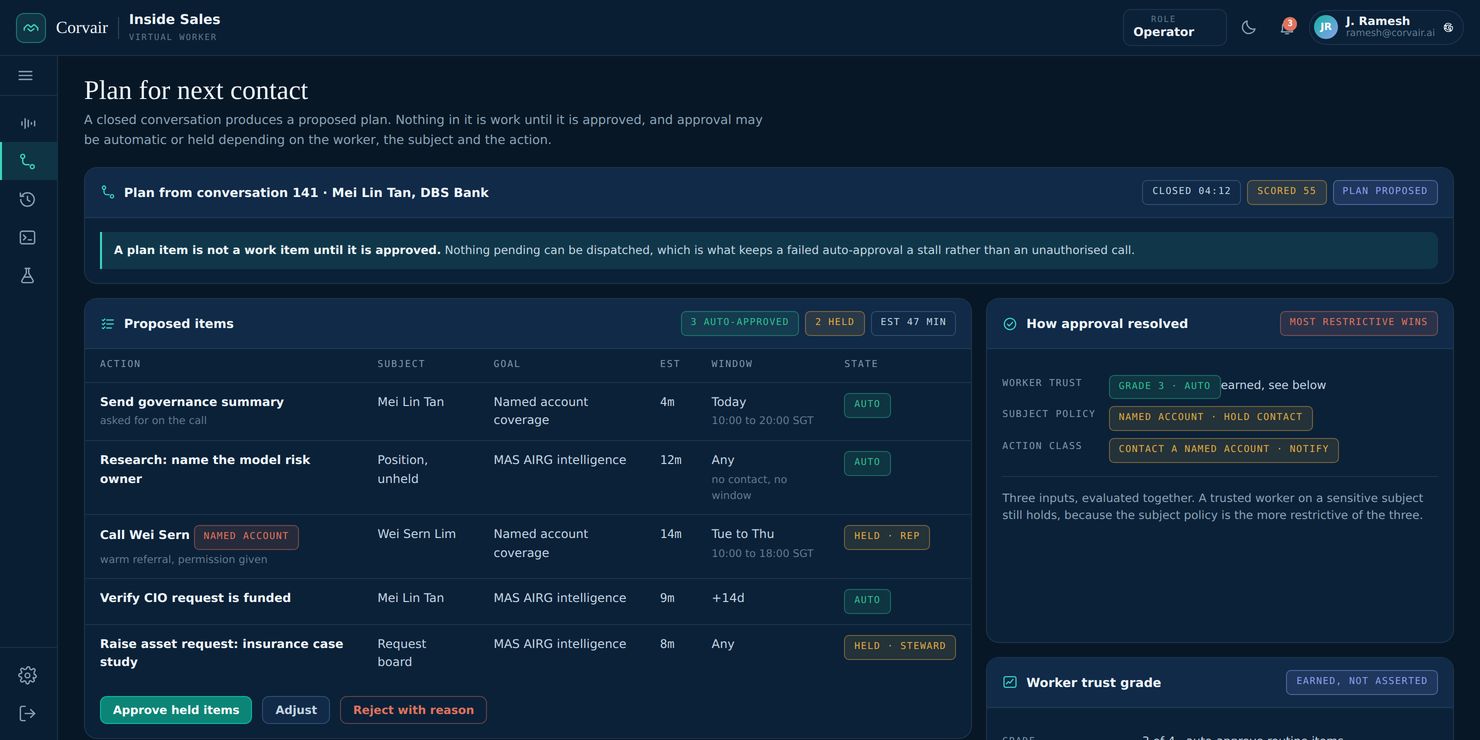
A plan item is not a work item until it is approved. That is structural rather than procedural: the pending state cannot reach the dispatcher at all. The consequence is that a stuck approval is a stall, which gets noticed, rather than an unauthorised contact, which does not get undone.
An earned grade, from plan acceptance rate, material edits, compliance findings and score stability.
This account is named, so hold all contact. Set per account, per segment or per portfolio.
Conveying a price is mandate bound wherever it appears, whoever is asking.
The most restrictive of the three wins, and they stay separate because they change for different reasons and on different timescales. A trusted worker on a sensitive account still holds.
Auto-approval is a promotion, and it is governed like one. The grade derives from calibration evidence rather than from an administrator's confidence, and it is revoked automatically the moment any input degrades past threshold, by the same watcher that rolls back a bad prompt version.
Trust that only a human can revoke is trust nobody revokes in time. The failure is silent right up until it is expensive.
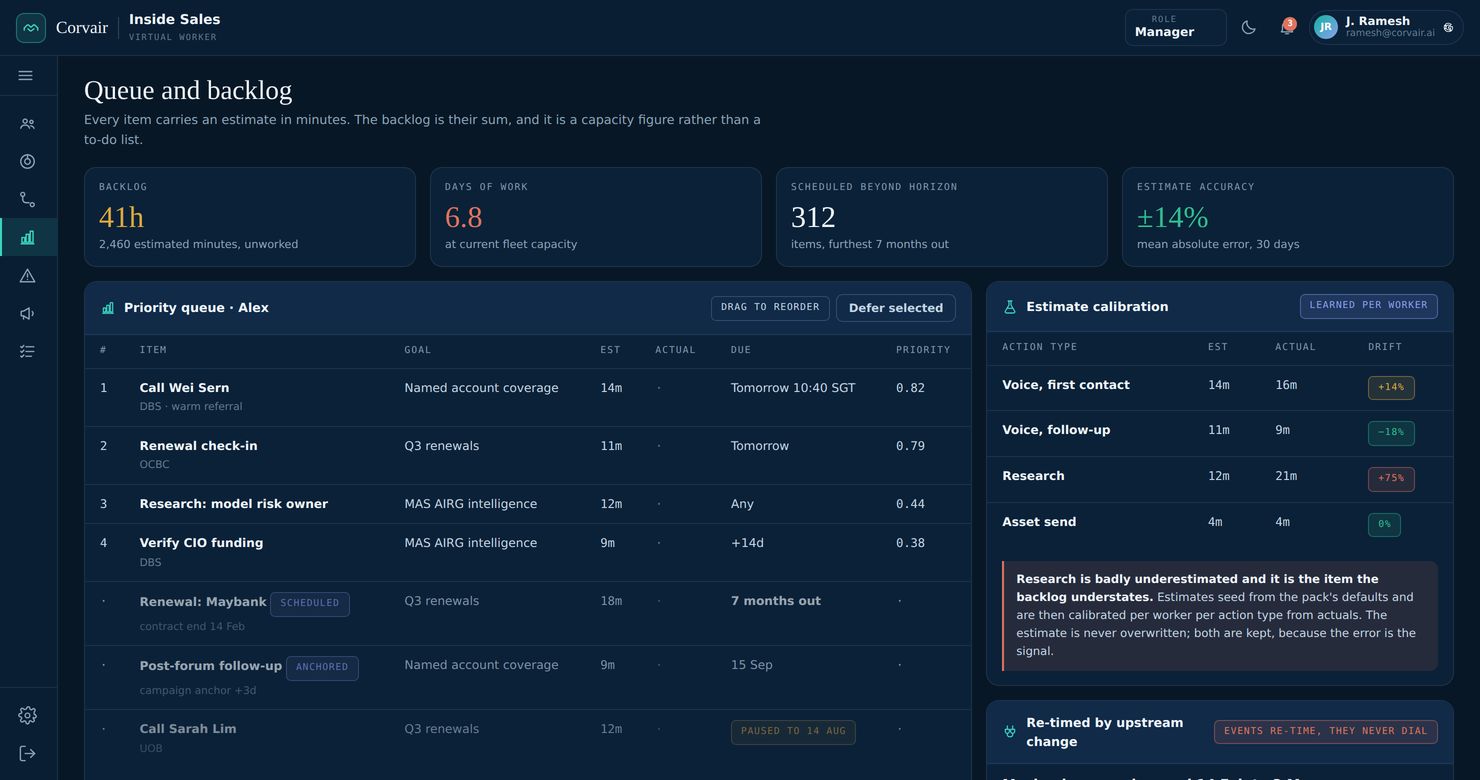
Estimates start from the worker pack's defaults for each action type, then calibrate to the individual worker from recorded actuals. Both numbers are kept, always. The estimate is never overwritten, because the gap between the two is the signal.
Forty-one hours of work means nothing on its own. Forty-one hours against your cycle length means everything. Seven days of backlog on a thirty day cycle is healthy. The same seven days on a five day cycle is a coverage miss you can prove weeks before the coverage report admits it.
The backlog decomposes by worker, by goal and by campaign, and the allocation floors apply to it. A goal starved in the backlog will be starved in the work, just later and less visibly.
Estimate accuracy is itself tracked, and it has teeth: if estimates are unreliable then the backlog is a lie, and every capacity decision resting on it is guesswork wearing a number.
Work can be scheduled far in advance, and an item may be anchored to a field in your own systems rather than to a fixed date. When the field moves, the item moves.
A contract end date shifts by a fortnight. Every anchored item reschedules against it.
Your contact leaves. The item re-points to the role, which survives the person.
The opportunity closes. Items are cancelled with a reason, never silently dropped, and the backlog falls.
None of this ever places a call. An upstream change moves or kills a plan item; the dispatcher still decides, at the moment of work, against every check. An event handler that can cause an attempt has broken the architecture, whatever the attempt was for.
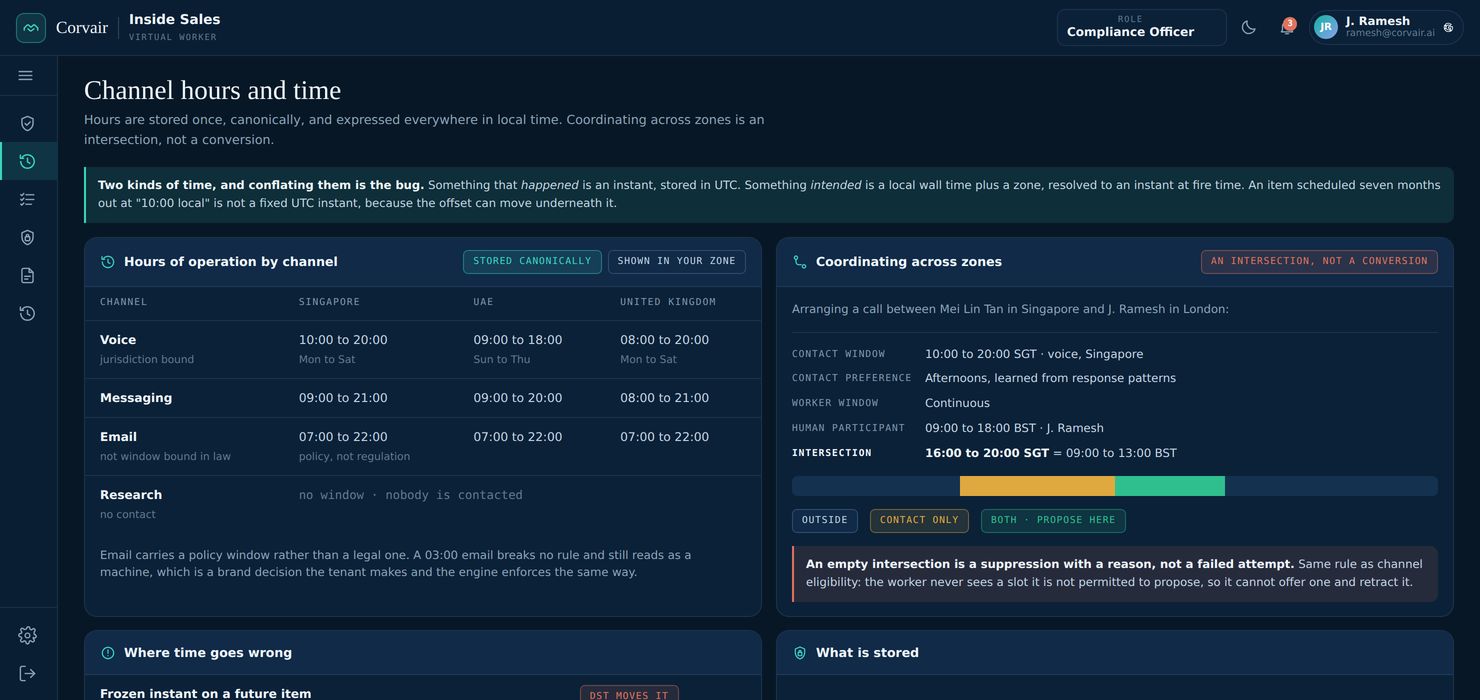
Something that happened is an instant, stored in UTC. Something intended is a local wall time plus a zone, resolved to an instant only when it fires.
An item scheduled seven months out at ten in the morning local is not a fixed point in UTC. Freeze it as one and a daylight saving transition moves it by an hour, which lands the call outside the permitted window. It passes every test written in a single time zone and fails in production, months later.
Voice is bound by law. Messaging sits between. Email generally is not window bound at all and still carries a policy window, because a three in the morning email breaks no rule and reads as a machine. Research has no window, because nobody is contacted.
The zone belongs to the contact, not to the account and not to you. A contact who relocates has every scheduled item re-resolved rather than rewritten.