arrow_backBack to the overview
Intelligence & work lists

What the conversation is for.

A worker that forgets who it met is an appointment setter.

Appointment setters are a commodity. A worker that accumulates a picture of who matters, how they relate, what they care about and who controls the money is something else entirely. That picture is the asset that compounds, and it is the one thing a competitor cannot copy, because it was built out of your own conversations.

A graphnot a pile of contact records
Role before namea seat exists before you know who fills it
Coveragea fact, not a spreadsheet
Why it lives in the engine

Every worker needs this, in the same shape.

The temptation is to treat relationship mapping as something the sales application does. It is not, and the reason is that the vocabulary differs while the structure does not.

support_agent

Inside sales

Maps decision makers, evaluation committees and budget authority. Who signs, who blocks, who was in the room last time.

home_work

Property operations

Maps owners, co-owners, agents, lien holders and the bank behind the file. Same structure, entirely different nouns.

account_balance

Collections

Maps who can actually agree an arrangement, which is frequently not the person on the account.

It outlives the worker

A stakeholder map built over eighteen months survives a prompt revision, a version change and a personnel change on your own side. Putting it in application code would tie institutional memory to a release, which is how companies end up with a CRM full of names and no idea who matters.

It makes the objective ladder executable

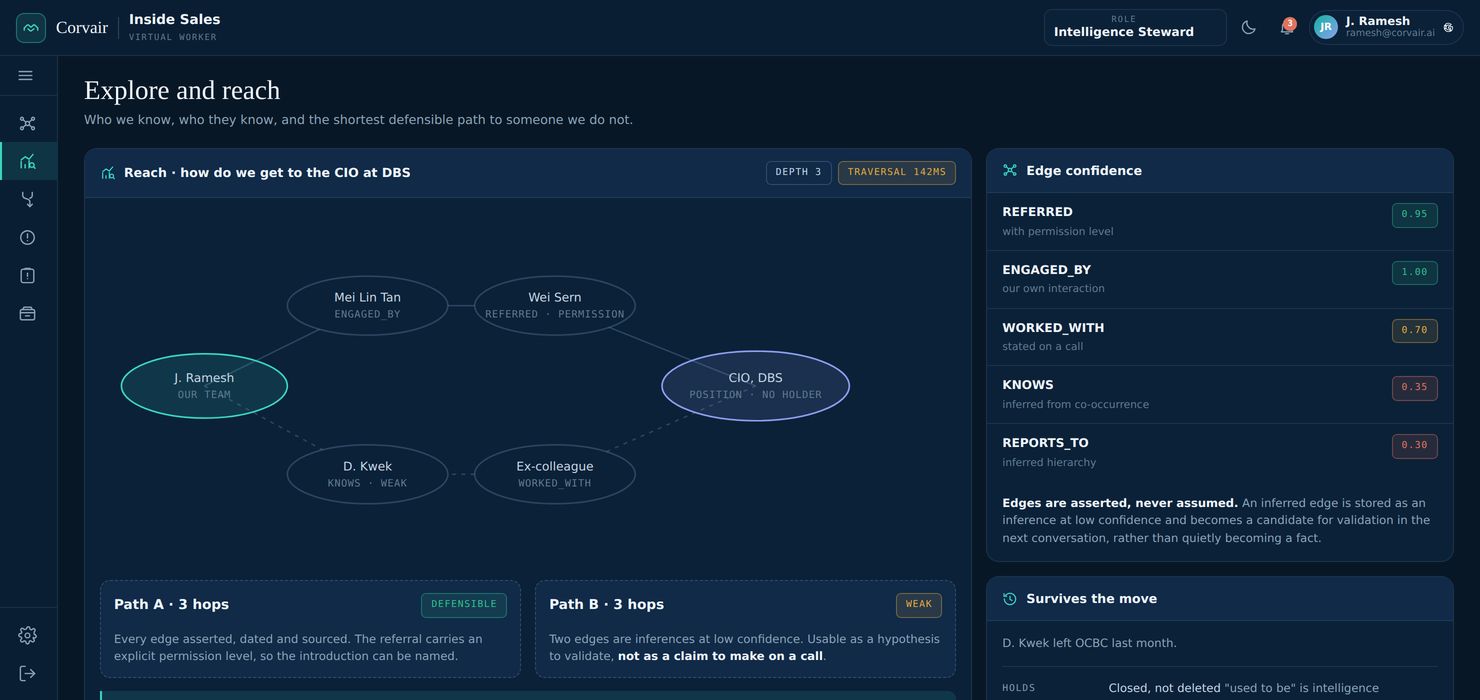
"Reach the economic buyer" only means something if the system knows who that might be and how to get there. Referral chains are paths through a graph whether or not anyone admits it, and a system that cannot walk them is guessing.

gavel
The obligations attach here too. Consent, suppression, purpose limitation and retention all attach to a person, not to an account or a campaign. Scattering people across application tables is what makes those obligations unenforceable in practice, however carefully they are written down.
The model

Four entities, and one distinction most systems get wrong.

Held as a graph rather than as records, because the questions that make it valuable are questions about paths.

EntityWhat it is
OrganisationA legal or operating entity, typed as prospect, customer, competitor, partner, adviser, regulator, supplier or intermediary. It may be several of these at once, to different parties
PersonA real human, who may be unresolved. Identity is provisional until evidence supports it
PositionA role within an organisation, as a thing in its own right. "The CISO at Bank A" exists whether or not anyone knows who holds it
AccountYour commercial view of an organisation, which is not the organisation itself

Separating organisation from account matters more than it first appears. A competitor is an organisation you track and will never sell to. A regulator is an organisation whose publications drive urgency and which nobody will ever call. If the only container available is an account, all of these become either absent or fake accounts, and the second is worse than the first.

An edge without a source and a date is an opinion, and the system does not store opinions as facts.

Relationships are typed, directional, time bounded, and carry a source and a confidence. Employment and role history. Hierarchy. Who knows whom, and who referred whom at what permission level. Who sponsors an initiative and who quietly opposes it. Who controls a budget and who merely influences the person who does. How the organisations around an account compete with, supply or advise each other.

Edges are asserted, never assumed

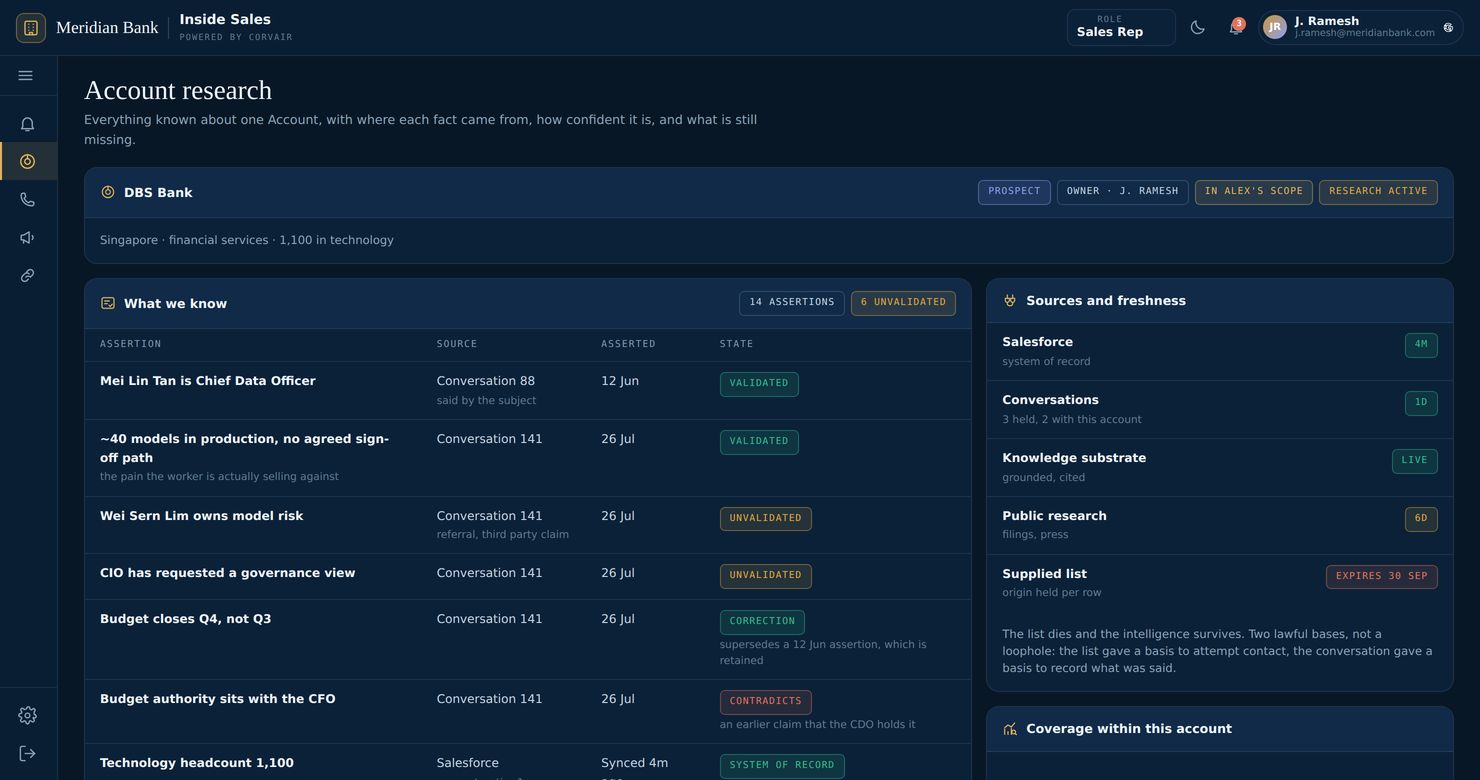
An inferred reporting line is recorded as an inference, at lower confidence, and becomes something the worker tries to validate in the next conversation. A guess dressed as a fact is worse than an admitted gap.

Edges are closed, not deleted

"Used to report to" is intelligence. "Used to work there" is how you find the person who can introduce you. History is not clutter to be tidied away.

Role before name

You learn the seat exists before you learn who sits in it.

"You'd want to speak to whoever runs security" is a real and useful piece of intelligence. A system that cannot hold it discards the most common output of a first conversation.

Observations, not attributes

A sentiment score with no date is worse than none.

Because it is a number someone will trust. Sentiment, influence, disposition and relationship strength are not properties of a person. They are dated assertions with a source.

trending_up

Trajectory

Sentiment over time is a series, so the change within one call sits inside a longer arc. An account cooling over two quarters becomes visible while it is still recoverable.

psychology

Assumptions that get tested

An assumption is simply an unvalidated observation. A conversation that contradicts one writes a new observation, marks the prior contradicted, and surfaces the correction. Nothing is silently overwritten.

fact_check

Influence you can trace

"High influence" resolves to the observations that produced it and the conversations they came from. Nothing corrodes trust in a system like a confident rating nobody can explain.

history
Nothing expires. Contradicted observations are kept, because they are the evidence behind every rating the system displays and the material the improvement loop learns from. Queries filter on whether an assertion is still believed, never on how old it is. The alternative quietly deletes exactly what you need when someone disagrees with a score.

Budgets are things, not fields

Who controls it, who influences them, which initiatives draw on it, when the cycle opens, and what a given role can approve without escalating. This is what turns "they mentioned money" into something a ladder can act on. An initiative with an identified funding source, an owner and a cycle date is a qualified opportunity. An initiative without one is a conversation.

One person, one record

Deterministic matching first, scoring second, and above a high threshold the system proposes a merge rather than performing one. Who approves is configurable: automatic above a threshold you set, the paired human who has met both of these people, or a named data steward. Every merge records what was combined and on what evidence, so it can be undone.

The boundary with your CRM

Deliberately, it knows more than your system of record.

What synchronises

Customers and prospects flow both ways: contacts, opportunity qualification, activity and stakeholder changes, each carrying its provenance and never overwriting a field a person typed. Every organisation type has its own policy, being full bidirectional, inbound only, outbound only or local, configured per customer because one organisation's data hygiene rules are not another's.

What does not, and why

Competitors, regulators, advisers, intermediaries, unbound positions and people known only by role. Most CRMs have nowhere sensible to put a competitor's head of product or a vacant seat at a prospect, and pushing them there degrades your own data, which is the fastest way to lose an administrator's goodwill.

visibility
We say this plainly rather than letting it look like drift. A customer reasonably assumes their CRM is the complete picture. With a virtual worker running, it is not, and that is the point: the graph is a superset, and the write back is filtered on purpose.
What it makes easy

Eight questions, each awkward against flat records.

A model is justified by the questions it makes cheap.

routePaths inWho at this organisation is connected to anyone we already know, and by what route?
groupsOur own relationshipsWhich of our people already have a relationship inside this account?
shareReferral provenanceTrace the chain that produced this contact, with the permission secured at each hop.
person_offGapsWhich positions in this account are unbound, and which of them matter?
swap_horizMovementWho has moved employer in our portfolio this quarter, and where did they go?
paymentsMoneyWho controls the budget this initiative would draw on, and who influences them?
hubMarket structureShow every organisation that competes with, supplies or advises this account.
list_altThe one that is not a queryWhich contacts have we not spoken to in ninety days at accounts showing initiative signals?

That last one is not a result set. It is a work list.

Work lists

The shape of work nobody models.

Ask anyone who does this job for a living what their week looks like and they will not describe tasks. They will describe lists.

The prospecting list. The renewal book. The quarterly touch on accounts that have gone quiet. The arrears run. The follow up from last month's event. Most systems have somewhere to record a single task and somewhere to record a multi-step process, and nothing at all for the shape in between: a set of subjects to be worked, at a rhythm, until a coverage condition is met. That gap is why so much operational work ends up in a spreadsheet someone exports on a Monday and nobody trusts by Thursday.

UnitScopeThe question it answers
Objective ladderOne conversationWhat am I trying to achieve right now?
FlowOne subject, several stepsWhat happens next, procedurally?
TaskOne action on one subjectWhat must be done, and when?
Work listMany subjects, over timeWho has not been worked yet, and are we on track?

Collapsing any two of these produces a failure everyone will recognise. A list implemented as a pile of tasks loses coverage, because a task knows whether it was done and nothing knows whether the set was finished. A list implemented as a process loses pacing, because a process advances on events rather than on capacity, and a virtual worker with capacity will burn a quarter's list in an afternoon.

Three axes

Origin, cadence, lifespan. Independently.

These get conflated constantly, and separating them is what makes the rest tractable.

AxisThe questionThe answers
OriginWhere did this come from, and therefore why are we contacting these people?Target account coverage, an intelligence operation, a marketing or event campaign, observed lead activity, or a cold and sourced import
CadenceHow often is it worked?One time, calendar recurring, rolling, anchored to an external date, or continuous while a condition holds
LifespanHow long does the list itself exist?Ephemeral, temporary with an expiry, or maintained indefinitely

Every combination happens. A target account book is coverage origin, recurring cadence, maintained lifespan. A rented marketing list is cold origin, one time cadence, temporary lifespan with a hard expiry. A competitor watch list is intelligence origin, rolling cadence, maintained lifespan, and nobody on it is ever called. A webinar follow up is marketing origin, date anchored cadence, ephemeral lifespan.

warning
Conflating them causes both failures that matter. Operationally, treating a maintained book as a campaign means somebody declares it finished and it quietly stops being worked. Legally, treating a temporary list as maintained means purchased data is still in the system three years after the basis for holding it expired.
Lifespan

Some lists end. Some never do.

task_alt

Ephemeral

An event outcome, a batch of enquiries, the follow up from one content action. Created, worked, closed.

timer_off

Temporary

Rented and third party marketing lists. The expiry is enforced rather than advisory, and rows that were never worked are deleted rather than archived, because there was never a reason to hold them beyond a contact that did not happen.

bookmark

Maintained

Target account books, competitor watch lists, alumni and former champion lists, renewal books. Membership evolves, the definition is curated, and each has a named owner.

gavel
The list dies and the intelligence survives, which is two lawful bases rather than a loophole. A supplied list gives a basis to attempt contact. A conversation gives a basis to record what a person chose to tell you. When the rented basis expires, the rows you never used have to go. What was learned in an actual conversation stands on its own footing, with its own retention and its own subject rights. Conflating the two is exactly how organisations keep purchased data forever by declaring that it "became CRM data", and holding origin and expiry on the row rather than on the file removes that move entirely.

Not every list is called

A competitor watch list exists to be observed. So a list declares a work type, being conversation, research, enrichment, verification or review. That is what lets a competitor or regulator list live in the same machinery as a prospecting list with no possibility of somebody dialling it.

A maintained list has an owner

Named, and reviewed periodically, in a review that questions the account set itself rather than only its coverage. An unowned standing list is how an organisation ends up working a strategy nobody currently believes in.

Origin

Two hundred names from a conference is not two hundred names from a broker.

A list is not a neutral container of names. Its origin determines its objective, its cadence, its lawful basis, its priority and what counts as success.

OriginWhat declares itThe objectiveSuccess is
Target account coverageA named account setThe conversion ladder, plus covering the account's own mapPositions covered and qualification depth, not calls made
Intelligence operationA declared target: a person, a position, an initiative, a competitor, a topicLearning. The declared questions become the ladderQuestions moved from unvalidated to answered
Marketing and eventAn event, a campaign or a content actionStage appropriate: invite, confirm, attend, follow upConversion inside a short and unforgiving window
Lead activityObserved behaviour on your own propertiesSpeed first, then qualification and routingTime to first contact, measured in minutes
Cold and sourcedAn import, or a query over the ideal customer profileDiscovery and permission before anything elseContact rate, and how many people become genuinely known
layers
Origin travels on the row, not just the list, because anyone worth talking to is on three lists at once. The dispatcher resolves which origin currently governs before the worker opens its mouth, so a person who downloaded a specification yesterday is never opened as a cold call today.
Campaigns

A campaign is not a folder of lists.

It is a first class object, and the understatement matters because the questions people actually ask are campaign shaped rather than list shaped.

What did the autumn programme cost. Did it hit its number. Which of its three stages produced the pipeline. Would a different message have done better. None of those is answerable from a list.

ElementWhat it carries
GoalsIts own targets, chartered to a marketing owner, delegated from the reps whose accounts are in scope, or both
ListsOne or many, each with its own origin, cadence, lifespan and stage. An event campaign is five
Anchor and timelineA target date, with every date anchored list inside it moving when that date moves
BudgetIts own ceiling, with the cost of every attempt in every list attributed to it
WorkersWhich workers may draw from its lists, and what share of their capacity it claims
Assets and messagingThe approved collateral, openings and positioning, versioned with the campaign
Compliance profileLawful basis, jurisdictions and disclosure set, resolved once rather than per list
VariantsWhere an approach is being tested, the alternatives and how membership divides
pie_chart
Campaign goals participate in the precedence model rather than sitting outside it. A campaign target competes with a coverage charter and with a rep's delegated goals under the same allocation rules, which is what stops a marketing programme quietly consuming a fleet budgeted for something else. A campaign needing sixty percent of a worker for three weeks declares it, and somebody with the standing approves it. And cost attribution is campaign first, so cost per outcome is a fact rather than an apportionment exercise at the end of a quarter. That is the number that decides whether the programme runs again.
science
And a campaign can be simulated before it runs. Resolve the membership, generate counterparties matched to its actual distribution, run at volume, and get projected coverage, cost per outcome, duration, the failure modes that surface, and the cheapest output of all: a compliance dry run telling you how many of these people are actually contactable, before anybody commits to a target. How campaign simulation works.

Target account books derive, they do not enumerate

A coverage list is not the contacts somebody chose. It is every subject at these accounts that satisfies a condition: every unbound position that matters, every contact untouched in ninety days, every person newly arrived in a relevant seat. The denominator is the map as you currently understand it, so a short list at a large account is a data quality finding, not an achievement.

Cold lists start with permission, not a pitch

The weakest basis in the system, so it carries the heaviest checks: a lawful basis declared per row rather than per file, tested against consent, suppression and registry status before anything is admitted, an expiry on the list itself, and rejected rows retained with a reason rather than dropped.

Intelligence operations

Declare a target, not a list.

The origin that does not exist in a conventional sales tool, and the one the relationship graph makes possible.

A target may be a person, a position, an initiative, an organisation, a competitor or a topic. Attached to it are the questions to answer: who is leading this programme, when does the incumbent's contract renew, who actually approved the last purchase, is this funded or aspirational.

route

The list is derived by traversal

Who holds a position adjacent to this initiative. Who has moved from the competitor into your portfolio. Who advises this organisation. Who was referred by someone already inside it. The list is the answer to "who could plausibly tell us", and it re-resolves as the picture changes.

swap_vert

The objectives invert

Everywhere else the conversion ladder is primary and intelligence is opportunistic. Here it is the other way round: the declared questions are the ladder, and a meeting is the standing objective, taken gratefully when it appears.

quiz

Success is answers, not activity

An operation closes when its questions reach the required confidence, or when it expires. A hundred pleasant conversations that answered nothing is a failed operation, and the platform says so rather than reporting the call volume.

policy
This is the sharpest edge in the product, and it is better stated plainly than buried. An operation that gathers information about a named individual is exactly the capability that should worry a reasonable person. So it carries a declared purpose in the operator's own words; a named approver who is not the requester whenever the target is an individual rather than an organisation or a topic; a hard expiry, so operations close or are explicitly renewed; scope limits, so an operation gathers what its questions require; and unaffected subject rights, because being the subject of an operation is not a reason to withhold anyone's access, correction or objection rights. And the declared purpose determines what may be gathered, with no purpose that authorises everything. Profiling a private individual for its own sake, or gathering protected characteristics, health or private life, is unavailable in a commercial sales operation because no lawful basis supports it, and the compliance engine is what withholds it. That is a legal floor rather than a product opinion, which is why the same platform can lawfully let an occupational health worker handle absence data: different purpose, different basis, different grant, same mechanism.
Events and campaigns

An event is five lists, not one.

A sequence over the same population, generated as the event's own state advances, each with a window that closes.

StageWho is on itThe failure mode
InvitationThe target audience, resolved from the account map and the campaign criteriaInviting after the deadline, which reads as incompetence
Registration chaseInvited, not yet registeredContinuing after they registered, which reads as not listening
ConfirmationRegisteredSilence. A missed confirmation is a no-show
Attendance reconciliationRegistered, attended or notTreating a no-show as an attendee, the most common data failure in event marketing
Follow upAttended, split by engagementFollowing up three weeks later, which is worth almost nothing

Cadence anchors to the date, and moves with it

Offsets forwards and backwards from the event rather than a set of fixed times. A conference postponed by a fortnight shifts every list in its campaign automatically, which removes the single most common source of embarrassing outbound in event marketing.

The event's own state drives membership

Registration, cancellation, attendance and no-show arrive from the event or webinar platform and move a person from one list to the next. Nobody re-runs an export, and nobody chases someone who already signed up.

verified
The strongest basis in the platform, and therefore the most constrained. The person acted: they registered, they attended, they asked a question. That is a basis for following up on the thing they engaged with. It is not a basis for adding them to an unrelated cold cadence afterwards, which is exactly what most organisations do with an event list, and precisely what recording the origin exists to prevent.
Lead activity

Somebody just downloaded your specification.

The most common source of real work in a marketing led business, and the one most often handled badly.

ActivityWhat it usually meansHow it is handled
Gated asset downloadActive research, and an identity you hold because they gave itImmediate item, opened on the asset they took rather than on a product pitch
Demonstration or contact requestExplicit intentHighest priority in the system, measured in minutes
Pricing page, repeatedlyLate stage evaluation, often by somebody who has never spoken to youItem, with the account's existing thread checked first
Documentation or specification pagesA technical evaluator, frequently not the person in your CRMAn unbound position worth resolving, more than a lead worth calling
Chat abandoned mid-conversationA question that went unansweredItem, opened by referencing the question
Email or sequence engagementAttention without commitmentPriority uplift on an existing item rather than a new one
Trial or free tier signupProduct led intentIts own flow, with usage as the qualifying signal
Return visit after a callThe conversation is still aliveSignal on the existing thread, not a new list entry
bolt

Priority decays, sharply

A form completed eleven minutes ago and one completed four days ago are not the same work, and a queue that treats them alike will lose the first. This is the one origin where the measure is time to first contact and a shortfall alerts in minutes.

visibility_off

Most web activity is anonymous

A page view has no person attached until an identifying action resolves it. Identifying the visiting organisation from network or firmographic data is an organisation level signal: it may raise an account's priority or create a research task, and it never identifies a person or authorises contacting one.

person_add

Enrichment is its own act

Turning a work email address into a full profile from third party sources is not implied by someone downloading a document. It is recorded as its own event with its own basis, and configured deliberately rather than switched on by default.

A static list is a snapshot. A dynamic list is a standing question.

Static membership

Enumerated at a moment in time. Right for a bounded campaign, and its virtue is an exact denominator, so coverage is a fact rather than an estimate.

Dynamic membership

A question asked of the relationship graph and re-asked at the start of every cycle. An account that starts showing initiative signals on Tuesday is in scope on Tuesday, and nobody has to remember to re-export anything. This is what makes work lists the operational face of the intelligence system rather than a second set of data that drifts away from it.

Cadence and dispatch

Campaigns end. Books cycle.

Treating a recurring book as though it exhausts is the most common mistake in this area.

schedule
Work is pulled, not pushed. A worker with capacity asks for its next subject and the system answers, running the caps, the spacing rules, the compliance check, the suppression state and then a priority calculation. This is not an implementation detail. Eligibility has to be evaluated at the moment of work, not at the moment of listing, because between a list being built and an item being worked the contact may have registered a preference, entered quiet hours in their own timezone, replied on another channel, been claimed by a colleague, or had their account reach a spend ceiling. A queue built in advance is stale by construction.

The priority calculation is deliberately arithmetic and inspectable, composed from list priority, time since last contact, how fresh the signal was that put the subject on the list, attempts already made, and how far behind pace the cycle is running. A seller or a supervisor will ask why this call and not that one, and the answer has to be a list of numbers rather than a model's opinion.

Coverage

Sixty percent through, four days left, two accounts blocked.

Said as a fact rather than an estimate. That sentence is what the whole structure exists to produce.

calculate
Attempted is not contacted. Six dials and no answer is six attempts and zero contacts. A coverage figure that conflates them is a number a manager will act on and should not. Suppressed and ineligible subjects are excluded from the denominator and reported separately, rather than quietly counted as done.
trending_down

Shortfall

The current pace will miss the target before the cycle closes. Raised early enough to do something about it, with the gap quantified rather than described.

check_circle

Exhaustion

Everything eligible was worked before the cycle ended. For a campaign that is success. For a recurring book it usually means the membership rule is too narrow, and it is reported as such rather than celebrated.

pause_circle

Stall

Subjects exist, capacity exists, and nothing is being worked, which almost always means an eligibility rule is excluding everything. Silent by nature, so it is detected deliberately.

The target is derived, then overridable

Proposed from the membership, the capacity available and the historical contact rate, and overridable by a supervisor with a recorded reason. A derived target is defensible on the first cycle where a declared one is a guess, and a supervisor who consistently overrides it is telling you the derivation is wrong, which is a more useful signal than the target itself.

Lists carry their provenance

Supplied and third party lists are accepted, on one condition: whoever imports declares a lawful basis for contact, per row rather than per file. Each row is resolved against people you already know, checked against consent, suppression and registry status, and anything that fails is recorded as suppressed with a reason rather than dropped. "Why is this person not being called" is a question that gets asked and needs an answer.

A conversation held under a list changes the picture. The changed picture changes who is on the list next time. That is the difference between a campaign tool and a worker that gets better at knowing who to talk to.

Next step

Bring an account and we will map it live.

The most useful demonstration of this is not a diagram. Give us a real account from your own pipeline, and watch the worker build the picture from a single conversation.