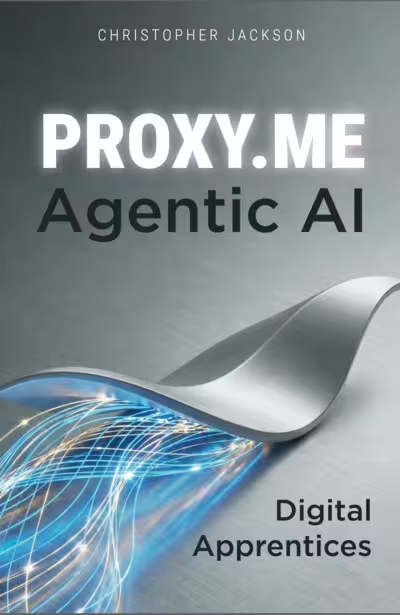
COMING APRIL 2026
Your AI investments are producing activity, not momentum.
Proxy.Me explains why, and shows how digital apprentices move from assistants to understudies that carry the work.
Proxy.Me explains why, and shows how digital apprentices move from assistants to understudies that carry the work.
Organizations are investing aggressively in AI. Individual tasks are faster. Documentation multiplies. Summaries appear instantly. Yet project timelines haven't shifted. Decisions take the same time. Approvals still pile up. Teams feel busier, not faster.
This is the AI Productivity Trap: the belief that if enough tasks are optimized, the system itself will accelerate. It won't. Because the friction that slows enterprises doesn't live inside tasks. It lives between them: missing context, invisible reasoning, ambiguous ownership, and coordination overhead that grows with every tool you add.
Proxy.Me is the first book to diagnose this structural problem and show the operational path forward: digital apprentices that manage durable work tickets, form coordination mesh networks, and progress from assistants to understudies that carry the enterprise's work.
"AI reduces the cost of creation but increases the cost of coherence." Chapter 4
The book opens with a diagnosis: organizations built around human labor as the primary unit of work are colliding with the capabilities of AI. The solution is not to bolt AI onto existing processes but to redesign the enterprise around digital apprentices called Proxies that carry the work.
Four chapters trace the root causes of organizational inertia from structural friction to knowledge loss to decision opacity to the AI productivity trap.
Four foundational principles that redefine how work moves through the enterprise. These are not practices to adopt; they are physics to design around.
The architecture in practice: how Roles, Proxies, workflows, and the Work Graph combine to create an enterprise designed for continuous motion.
How execution, leadership, and teams transform when the system is designed for continuous motion.
The broader implications: enterprise dynamics, governance, culture, transformation, and the evolving role of HR.
The closing argument: abundant intelligence does not confer advantage. Judgment does. The Epilogue returns to the human dimension of a system designed for continuous motion.
Organizations rarely slow down because people resist progress. They slow down because the system cannot convert intention into motion. Work stalls not at the point of execution but at the point of initiation. Every new task requires a sequence of clarifications, approvals, and meetings before real work begins. This is structural inertia.
Knowledge is the most valuable asset in any modern enterprise, yet it behaves in the least beneficial way: it settles into pockets, gathers in individuals, and remains trapped in the heads of people who carry the most context. When reasoning is invisible, teams challenge decisions unnecessarily, the same debates reappear cyclically, and leaders become bottlenecks.
The pivotal diagnosis: AI reduces the cost of creation but increases the cost of coherence. More output requires more coordination. AI can make individuals faster while making the organization slower. This is the AI Productivity Trap.
"Organizations don't slow down because they lack intelligence. They slow down because their intelligence is invisible." Chapter 3
Key Insight: Corporate amnesia is not inevitable. It is a design failure, and a reversible one. When knowledge flows, it compounds.
Four foundational principles redefine how work moves. First, humans shift from executors to catalysts who teach the system rather than performing tasks. Second, opaque authority (pushing work past friction by relying on the decision-maker's presence) gives way to curated logic embedded in the Role. Third, Roles are redesigned for decision-making: a Kinetic Role is not a title paired with responsibilities but a decision-making mechanism. Fourth, flow replaces tasks as the real unit of organizational work.
"In a refinery, operators do not carry barrels; they regulate flow. In the Kinetic Organization, leaders do not carry the work; they ensure the work carries itself." Chapter 5
Key Insight: A job description specifies what someone is expected to do. A Kinetic Role tells someone how to think. A job description supports employment. A Kinetic Role supports momentum.
A Kinetic Role replaces static task lists with a living reasoning system including Lenses (interpretive frameworks), Veto Lenses (non-negotiable boundaries), Points of View (configurable stances), and Scenarios (environments that reshape how the Role thinks). The Proxy is a composite intelligence that interprets the world on behalf of the Role, maintains dynamic memory, takes action within governance boundaries, and communicates with other Proxies.
Dynamic workflows replace rigid process flows with context-sensitive routing through the mesh. The Work Graph reveals how work actually moves. The Kinetic Operating Model integrates four layers: Role Architecture, the Proxy Layer, the Work Graph, and the Orchestration Layer.
"Judgment establishes direction. Continuity creates motion." Chapter 10
Key Insight: Traditional organizations orchestrate through meetings. Kinetic Organizations orchestrate through structure.
Execution becomes what the system generates through structure rather than what individuals struggle to produce. Kinetic leadership is architectural, not heroic: the leader's job is to shape the conditions under which work is carried out, not to carry the work. Kinetic Teams form because a flow pattern requires specific Roles, not because people share reporting lines. Leadership shifts naturally as scenarios shift.
"Leadership ceases to be about holding everything together. It becomes the act of designing a self-assembling system." Chapter 16
When Roles, Proxies, Scenarios, and the Work Graph interact at enterprise scale, collective capability emerges. Governance embeds control inside motion itself, making violations structurally unlikely rather than punishable. Culture emerges from structure rather than compensating for what structure lacks.
Five transformation principles govern the shift: flow before function, structure before culture, judgment before metrics, continuity before change, and learning before scale. HR elevates from administrative to architectural, stewarding the relationship between People, Roles, and Proxies.
"The Kinetic Organization is not a metaphor for working faster. It is a blueprint for staying human inside complexity." Chapter 21
Key Insight: The most dangerous failure mode of this era is not malicious automation. It is the illusion of control.
Six levels from Static Organization (Level 0) through Universal Kinetic (Level 5). Describes how work moves through organizations, where judgment resides, and how much human effort is required to convert intent into action.
Read moreTwelve organizational archetypes across four quadrants (Inertia, Visibility, Augmented, Kinetic) describing observable patterns in how work moves. Archetypes are not identities; they are gravity wells.
Read moreAn end-to-end vendor procurement example demonstrating how structured reasoning with shared Points of View, Lenses, and Veto Lenses produces decisions that are auditable, consistent, and reusable.
Read moreA governance framework distinguishing three categories of AI actors, six deployment contexts ordered by governance complexity, and practical frameworks for constraining the mesh.
Read moreTraditional job descriptions define what someone does. Kinetic Roles define how a position thinks, using interpretive lenses, veto boundaries, configurable points of view, and scenario-aware logic. The apprentice is tied to the Role, not the person. When someone leaves, the next occupant inherits a trained apprentice, not a blank slate.
(Chapters 7, 9)
Not chatbots. Not copilots. Proxies are digital apprentices that carry the work: they manage tickets, maintain context, coordinate with other apprentices, learn from escalation, and continue operating within authorized boundaries even when their human partner is unavailable.
(Chapter 10)
Knowledge workers have inboxes, not workflows. Work arrives via email, Slack, meetings, and hallway conversations, then scatters with no trace. Every act of knowledge work must be captured as a durable case managed by the apprentice. The ticket is the atom of organizational motion.
(Chapters 10–11)
Individual assistants produce individual productivity. What changes the system is apprentices that coordinate with each other through a mesh network with smart flags for work routing and orchestration. When all Roles have apprentices, direct machine-to-machine coordination emerges.
(Chapters 11–12)
Org charts show reporting lines. The Work Graph shows how work actually moves, built from thousands of apprentice observations across the mesh. It reveals where flow accelerates, where it stalls, and where the enterprise is structurally vulnerable.
(Chapter 12)
"Clarity is not a soft skill. Clarity is infrastructure." Chapter 3
"Automating a task accelerates the moment. Orchestrating the system accelerates the work." Chapter 4
"Work moves at the speed of shared understanding, not at the speed of individual output." Chapter 8
"It feels like the system is carrying us instead of us carrying it." Chapter 13
"Teams don't create coherence; they reveal whether the system has any." Chapter 17
"Abundant intelligence does not create an advantage. Judgment does." Epilogue
Christopher Jackson brings 35+ years spanning enterprise data, analytics, and AI governance. From 11 years at Teradata (Director of Platform Architecture, Global Emerging Markets and APJ) to founding Corvair Pte Ltd, he has delivered complex data and analytics solutions to banking, financial services, and regulated enterprises across Western and Asian regulatory frameworks. A graduate of the NUS Chief Strategy Officer programme, Jackson writes from direct experience designing systems that must work under real operational pressure, not from theory.
Proxy.Me is narrated by the author in the audiobook edition.
Available in print, e-book, and audiobook (read by the author).
Get the Book Free Sample Chapters