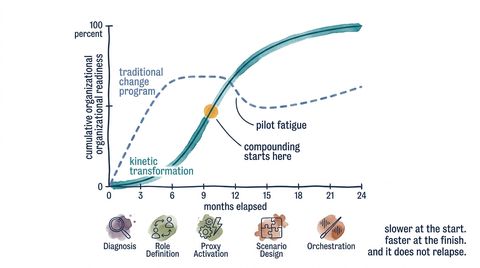
Proxy.Me explains why, and shows how digital apprentices move from assistants to understudies that carry the work.
Always on. Always learning. Always helpful. Fully governed.
Enter your email to be notified when Proxy.Me is available for purchase. No spam, just a single notification on launch day.
Apprenticeship is how humanity has transferred judgment for thousands of years. Proxy.Me makes it the design pattern for the age of abundant intelligence.
What if your assistant truly understood your role in your organization, what you are accountable for, and who depends on you?
What if it held your institutional knowledge, knew exactly where its authority ended, learned your judgment rather than just your instructions, and got better with every case it handled?
Proxy.Me answers with a single idea: the digital apprentice. Today's AI makes individuals faster, yet the organization still moves at the speed of its handoffs, approvals, and meetings. The Proxy is built for that gap: it persists, remembers, reasons, and learns.
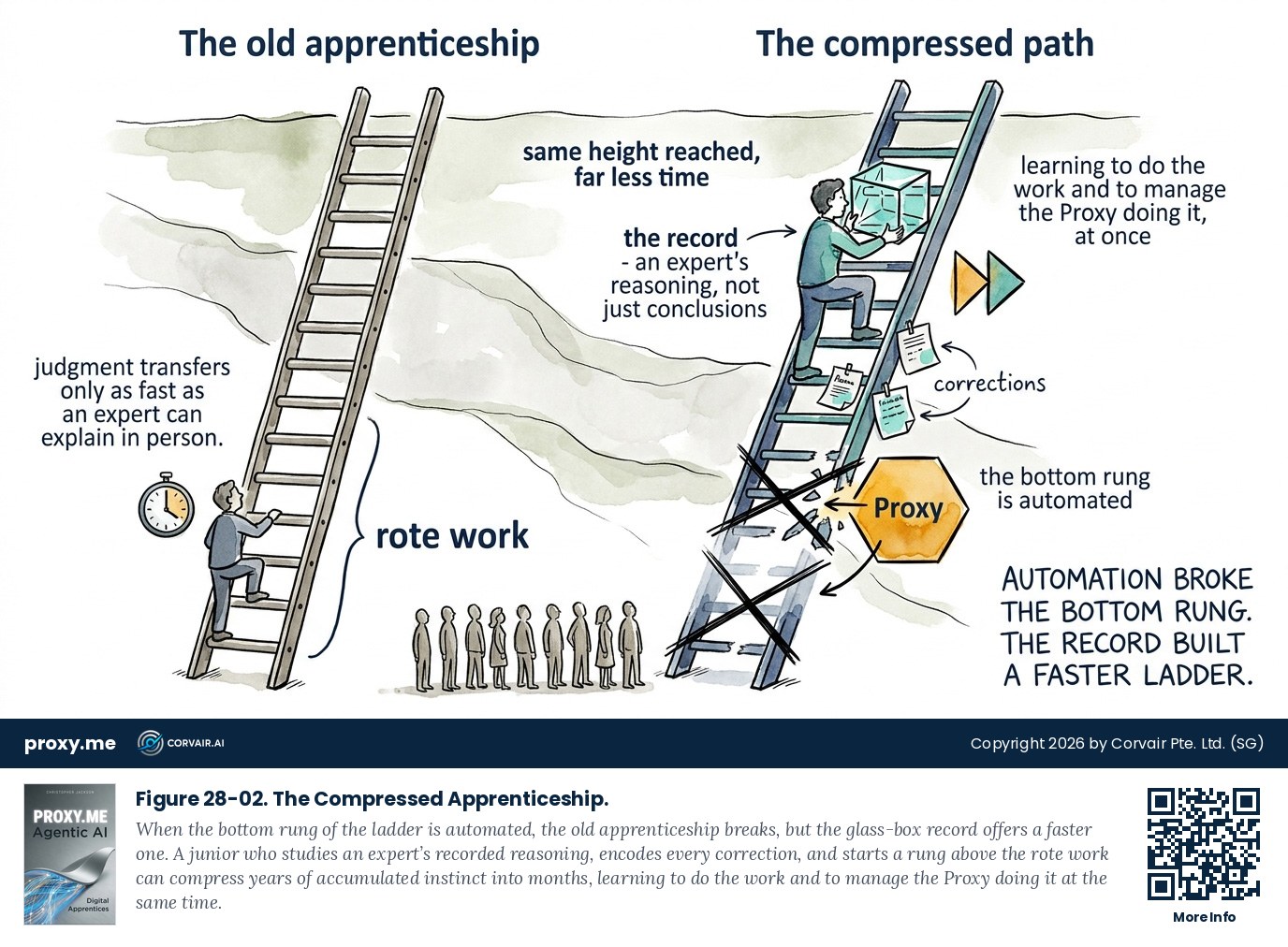
For thousands of years, judgment has passed from master to apprentice: watching the work, practicing under correction, gradually being trusted with more of the craft. The Proxy learns the same way, at the elbow of the person who holds the Role.
Figure 28-02. The Compressed Apprenticeship
Not automation that replaces people.
Augmentation that finally scales what they know.
28 chapters in six parts. Each part answers one question.
Explore every chapter, the appendices, and the book's vocabulary arrow_forward
118 hand-drawn watercolor figures make the architecture tangible, and every one is free to browse. Audiobook listeners follow along by figure number.
Nine executive roles, each with its own perspective page. Both CROs are here deliberately: risk and revenue are different roles with different lenses.
The CEO's job in this era isn't unblocking execution. It's deciding whether the system can carry it.
Read arrow_forwardMesh architectures, identity propagation across agents, and the Work Graph as a first-class data structure.
Read arrow_forwardFrom data plumber to architecture architect: designing the conditions under which intelligence can move safely.
Read arrow_forwardWhen controls are designed into how work moves, risk management becomes anticipatory rather than corrective.
Read arrow_forwardA single agent has modest permissions. A chain of coordinating agents has combined permissions no role ever intended to authorize.
Read arrow_forwardThroughput without burnout. When the operating model carries the work, operations stop firefighting and start tuning.
Read arrow_forwardThe strategy you write today has to survive AI's reshape. The firm that arrives first at the new operating model writes the rules.
Read arrow_forwardPredictable revenue, not heroic revenue. Judgment around pricing, risk, and exceptions embedded in the Role, not carried in heads.
Read arrow_forwardMost AI transformation programmes are tool deployments dressed up. The work that moves the needle is reshaping how work flows.
Read arrow_forward
Get the Introduction and the first two chapters free, plus one launch-day note when the book goes live July 10. That's it: no drip campaign.
All five appendices, including the glossary, will also be free at launch.
"AI reduces the cost of creation but increases the cost of coherence." Chapter 4
"In a refinery, operators do not carry barrels; they regulate flow. In the Kinetic Organization, leaders do not carry the work; they ensure the work carries itself." Chapter 5
"Judgment establishes direction. Continuity creates motion." Chapter 10
"Structure describes intention. Flow reveals truth." Chapter 13
"It feels like the system is carrying us instead of us carrying it." Chapter 14
"The Kinetic Organization is not a metaphor for working faster. It is a blueprint for staying human inside complexity." Chapter 25
"Abundant intelligence does not create an advantage. Judgment does." Epilogue
Proxy.Me shows you what your organization becomes when AI carries the work: the architecture, the roles, and the governance to run it.
A working architecture of Roles, Proxies, tickets, and the mesh that you can start building today with the systems and people you already have.
Proxy.Me redesigns the physics of how work moves through the enterprise, so faster tasks finally add up to a faster organization.
Written from decades inside regulated enterprises: every mechanism ships with its governance model, so speed and safety reinforce each other.
Christopher Jackson brings 35+ years spanning enterprise data, analytics, and AI governance, including senior roles at Teradata and Oracle. From 11 years at Teradata (Director of Platform Architecture, Global Emerging Markets and APJ) to founding Corvair Pte Ltd, he has delivered complex data and analytics solutions to banking, financial services, and regulated enterprises across Western and Asian regulatory frameworks. A graduate of the NUS Chief Strategy Officer programme, Jackson writes from direct experience designing systems that must work under real operational pressure, not from theory.
Proxy.Me is narrated by the author in the audiobook edition.
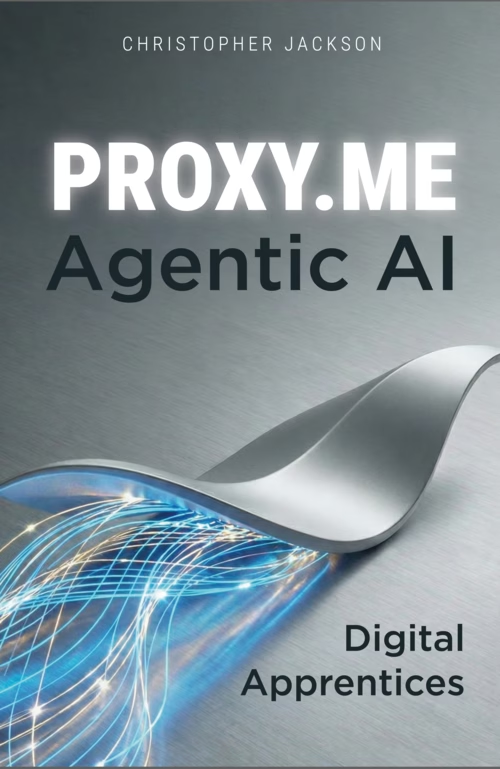
Available in print and e-book July 10, 2026. Audiobook, read by the author, to follow later in 2026.
Get the Book Resources