Proxy.Me · Perspectives
Master and apprentice. A 700-year-old answer.
Why apprenticeship beats training, for humans and for AI.
Why apprenticeship beats training, for humans and for AI.
Most corporate learning is built on a quiet assumption: that the right answer can be written down in advance. Curriculum design starts with learning objectives, which are statements of what the learner should know by the end. The objectives drive the content, the assessment, and the certification. The model has carried us a long way.
It also has a ceiling. For routine work it is excellent. For complex judgment work, where the right answer depends on context that didn't exist when the curriculum was written, it produces brittle workers who know the procedure and freeze when the procedure doesn't fit. Anyone who has trained a junior into a senior role knows the gap. The procedure was the easy part.
Master and apprentice has worked for seven hundred years. We just got new apprentices.
Apprenticeship is older than every modern training framework, and it works for the same reason now as it did in the fourteenth century. The apprentice watches. The master corrects. The corrections happen in the actual work, on the actual problem, with the actual stakes. Knowledge that took a master twenty years to develop transfers in a few because it transfers in context, not in slides.
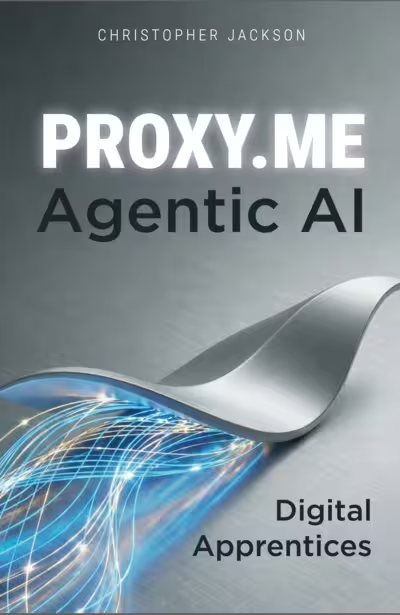
The book maps this directly onto AI. A persistent agent moves through three phases that any guild master would recognise. Assistant: it observes and prepares, escalating frequently. Understudy: it acts in many situations and defers on the novel ones. Apprentice: it carries the role's full reasoning, escalates with precision, and continues to learn from every interaction. The same lifecycle, with new apprentices.
Companies that adopt apprenticeship as their AI training model will end up with agents that match how their best people actually work. Companies that stick with formal training pipelines will end up with agents that match the spec, not the work. The difference is small at first and compounds quickly.
The bet behind the book is that the seven-hundred-year-old answer is also the right answer for what comes next. Different stakes, different stakes-keepers, but the same shape: master, apprentice, time, and corrections in context.
Including Chapter 5 (Human as Catalyst), Chapter 10 (Role Proxy), and Appendix D on the apprentice lifecycle. By Christopher Jackson, July 10, 2026.
Read about the book arrow_forwardNo spam. One email when Proxy.Me is available.