The CDO mandate is shifting from deploying technology to designing the conditions under which intelligence can move safely through the enterprise.
The CDO role grew up around plumbing: warehouses, pipelines, lakes, governance frameworks for data at rest. That work doesn't go away, but it stops being the differentiator. The next chapter is about what happens once intelligence acts on that data persistently, autonomously, and across systems.
The new mandate is to design the conditions under which intelligence can move safely. Not move it. Make it safe to move.
Once an apprentice draws on a knowledge base to make a decision, that knowledge becomes load-bearing. Provenance matters. Freshness matters. Whether a note that informed yesterday's decision is still valid today matters. The book lays out seven verbs of knowledge management (build, distill, validate, refresh, curate, archive, forget) and an attestation chain that makes any reasoning step reconstructible from the evidence.
A knowledge base that cannot forget cleanly is a compliance liability. A knowledge base that forgets without a trace is an audit liability.Proxy.Me · Appendix B
The architectural questions sit at the intersection of data, identity, and reasoning. Which knowledge sources are canonical, which are local, which are licensed. How attestation propagates across multi-agent flows. How drift in either the data or the reasoning gets detected before it becomes a problem.
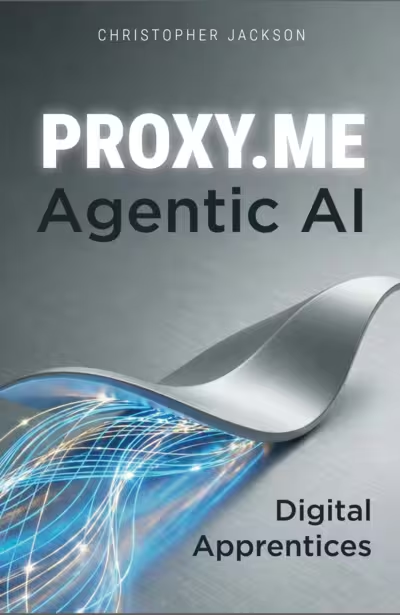
Proxy.Me is the architectural reading for the CDOs who want to lead this conversation rather than respond to it after the fact.
Including Appendix B (knowledge management, four sources, the attestation chain) and Appendix C (mesh-level governance of shared reasoning libraries). By Christopher Jackson, May 2026.
Read about the book arrow_forwardA single email when Proxy.Me is available.