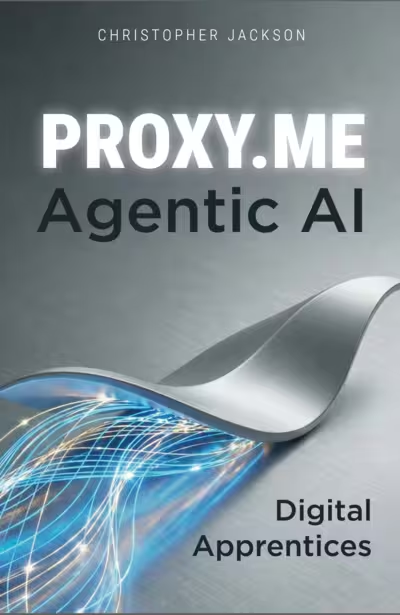
Proxy.Me · For the CTO
The systems you build now decide what scales.
The architecture choices being made today around agents, meshes, and governance will define what enterprises can do for the next decade.
The architecture choices being made today around agents, meshes, and governance will define what enterprises can do for the next decade.
Every era of enterprise technology had a moment where the architecture got fixed. The mainframe did. Client-server did. The web did. Cloud did. Each set of decisions absorbed the next decade of investment. The teams that got the architecture right rode the curve. The teams that didn't spent ten years apologising for their stack.
Agentic AI is in that moment now. The systems being built this year decide what's possible to build next year, and the year after that.
The next generation of enterprise architecture is being decided now.
An agent on its own is a feature. A mesh of agents that coordinate, share state, propagate identity, and produce reconstructable evidence is infrastructure. It deserves the architectural rigour the enterprise gave its data plane and its event bus, because it will end up carrying as much weight as either of them.
Proxy.Me treats the mesh as a first-class architectural object. Topology, identity propagation, agent-to-agent protocols, the Work Graph as a data structure, the cumulative authority of multi-agent flows. Decisions to be made deliberately, not absorbed accidentally.
The teams writing this architecture have a chance manufacturers had with safety in the early 20th century: the chance to design controls into the structure, not bolt them on later. Veto lenses. Authority caps that respond to scenarios. Replayable evidence as the audit substrate. Drift detection as continuous monitoring rather than periodic review.
For CTOs setting the direction, Proxy.Me is the architectural reference. The decisions are coming whether or not the framework is in place.
Including four governance appendices on actor taxonomy, reasoning and reach, mesh governance, and the apprentice lifecycle. By Christopher Jackson, July 10, 2026.
Read about the book arrow_forwardNo spam. One email when Proxy.Me is available.