If you're running an AI transformation programme, there is a non-trivial chance you're running the wrong programme. The work that moves the needle is the work most programmes never start.
The familiar shape: a vendor selection, a few pilot teams, a steering committee with quarterly status. The artefacts look like transformation. The decisions look like transformation. But none of it touches the operating model. None of it explains why throughput hasn't moved a year in.
This isn't a fault of the people running the programme. The playbook they inherited was built for a previous kind of change: deploy systems, train users, manage adoption. AI transformation needs a different playbook because the change is structural, not technical.
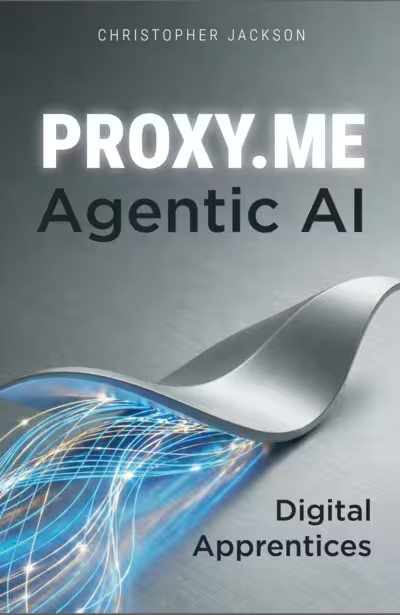
The book lays out the destination concretely. Roles redefined as judgment systems. Persistent apprentices that carry the work between humans. A mesh that lets apprentices coordinate without funnelling everything through their humans first. A Work Graph that makes flow visible at the enterprise level.
Sequencing matters more than scope.Proxy.Me · Chapter 24
The sequence the book lays out doesn't ask the organisation to redesign itself in one motion. Start where the friction is most visible. Pick the role most ready for an apprentice. Let the rest of the system absorb the change as it learns from the pilot. The mesh forms because the work demanded it, not because the programme decreed it.
For transformation leaders, Proxy.Me is the architectural reading list. The framework that turns "AI transformation" from a vague programme charter into a concrete sequence of operating-model changes that compound.
Including Chapter 24 (Kinetic Transformation) on the sequence, the destination, and the principles that govern the path. By Christopher Jackson, May 2026.
Read about the book arrow_forwardA single email when Proxy.Me is available.