Proxy.Me · Perspectives
When your best person leaves, the system forgets.
Most institutional knowledge isn't in your documents. It's in your people. The next generation of AI changes which one of those statements is true.
Most institutional knowledge isn't in your documents. It's in your people. The next generation of AI changes which one of those statements is true.
When a twenty-five-year veteran leaves, what goes with them is not the resume. It's the trade-offs they would have made in a meeting next Tuesday. The exception that cleared in 2018 and shouldn't be repeated. The supplier that delivered when nobody else could, and the one that quietly never delivered on time but charged less. The reason the team always spends a day on something that looks unnecessary on paper. The accumulated scar tissue.
The handover document catches maybe ten percent. The rest takes years to rebuild, if it gets rebuilt at all. By the time the new occupant has reconstructed even part of it, the world has moved on, and so has the next person.
Corporate amnesia is not inevitable. It is a design failure, and a reversible one.
The standard answer to corporate memory loss is more documentation. Wiki it. Note it. Put it in the runbook. Most organisations have tried this for decades. Most organisations still pick up the phone when something matters.
The reason is simple. Documents capture conclusions, not reasoning. They don't update when context changes. They reflect what the writer thought was important on a Tuesday afternoon, not what the reader needs at three on a Friday in a different scenario. Search finds them. People skim them. And then they call the one human who still remembers why.
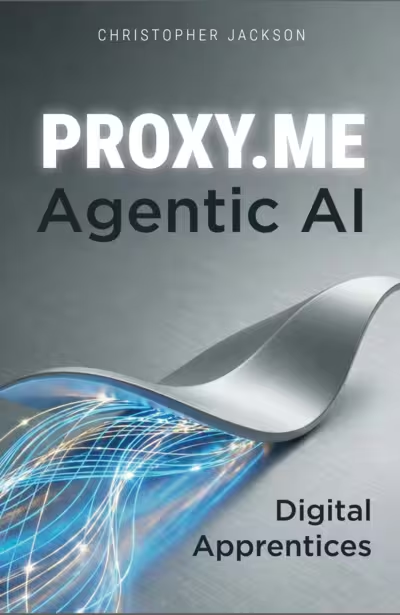
The book proposes a different shape. An apprentice bound to the role rather than to any individual occupant. It learns the role's reasoning, the lenses that shape the work, the scenarios that change the routing, the decisions that fired this year and the ones that fired last year. When the person changes, the apprentice stays. The successor inherits a partner that already knows how the role thinks.
Memory that compounds, year over year, role over role, instead of memory that evaporates with every farewell email. Continuity stops being a heroic act of documentation and becomes a property of the system.
Including Chapter 2 on Knowledge at Rest, Chapter 14 on momentum, and Appendix D on persistence. By Christopher Jackson, July 10, 2026.
Read about the book arrow_forwardNo spam. One email when Proxy.Me is available.