Proxy.Me · Perspectives
Will AI agents take my job?
The conversation is dominated by fear. The opportunity is the time you get back, and the parts of your work that finally get the attention they deserve.
The conversation is dominated by fear. The opportunity is the time you get back, and the parts of your work that finally get the attention they deserve.
For most knowledge workers, the days are full of work that nobody hires you for. Status updates that aren't really updates. Meetings to align on what was decided. Re-explaining the same context to a new stakeholder. Hunting for the latest version of a file. Recovering from yet another interruption.
That coordination overhead consumes most of the week, and almost none of it is what made you good at the job in the first place. The next generation of AI is set up to take that part off your plate, and to leave you the part that's actually yours.
The decisions that matter, made with the depth they deserve.
Real conversations with clients, colleagues, and partners.
Creative work that needs space to develop, not just slots to fit into.
AI doesn't take your job. It gives you back your week.
Some jobs, especially white-collar knowledge work that is mostly coordination, status, and routine analysis, will compress or disappear. AI is genuinely disruptive, and pretending otherwise doesn't help anyone prepare for it.
What matters most is that "augmented" versus "automated" is rarely an individual choice. It is an organisational decision. Some organisations will use AI to remove people. Others will use it to remove the parts of work that nobody wanted to do in the first place, and free their people to do what only humans can.
One path produces a one-time cost cut. The other produces compounding value, year after year. Augmentation isn't the softer story. It's the more profitable one.
The book's central argument is structural. The biggest gains aren't from replacing workers. They come from reconfiguring how work moves between them. When the coordination tax falls, the value of human judgment rises. When AI carries the routing and the context-stitching, people can do more of what they were hired for.
This is a collaboration system, not a replacement system. Every person works alongside an apprentice that learns their role. Every apprentice can talk to every other apprentice through a shared mesh. The lift is collective. The total value created by reconfiguring the flow exceeds anything the same headcount could produce by working harder.
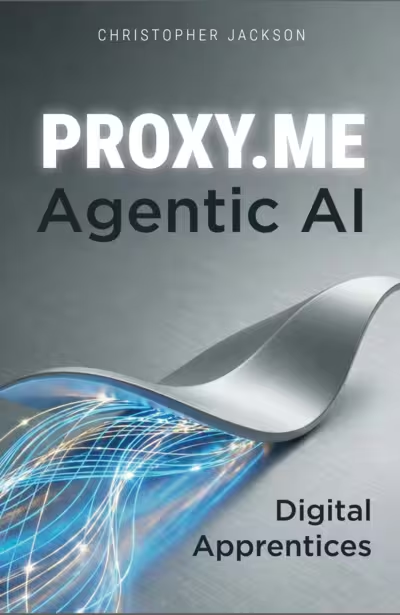
A complete operating model for the era after the AI assistant. By Christopher Jackson, July 10, 2026.
Read about the book arrow_forwardNo spam. One email when Proxy.Me is available.