More client work.
Room to grow.
Give each client team more capacity to deliver. Corvair’s AI Harness coordinates virtual workers, playbooks, decisions and follow-through under each client’s name and rules, with its knowledge, permissions and connected systems kept separate.
Book a demoA shared operating view.
Every client distinct.
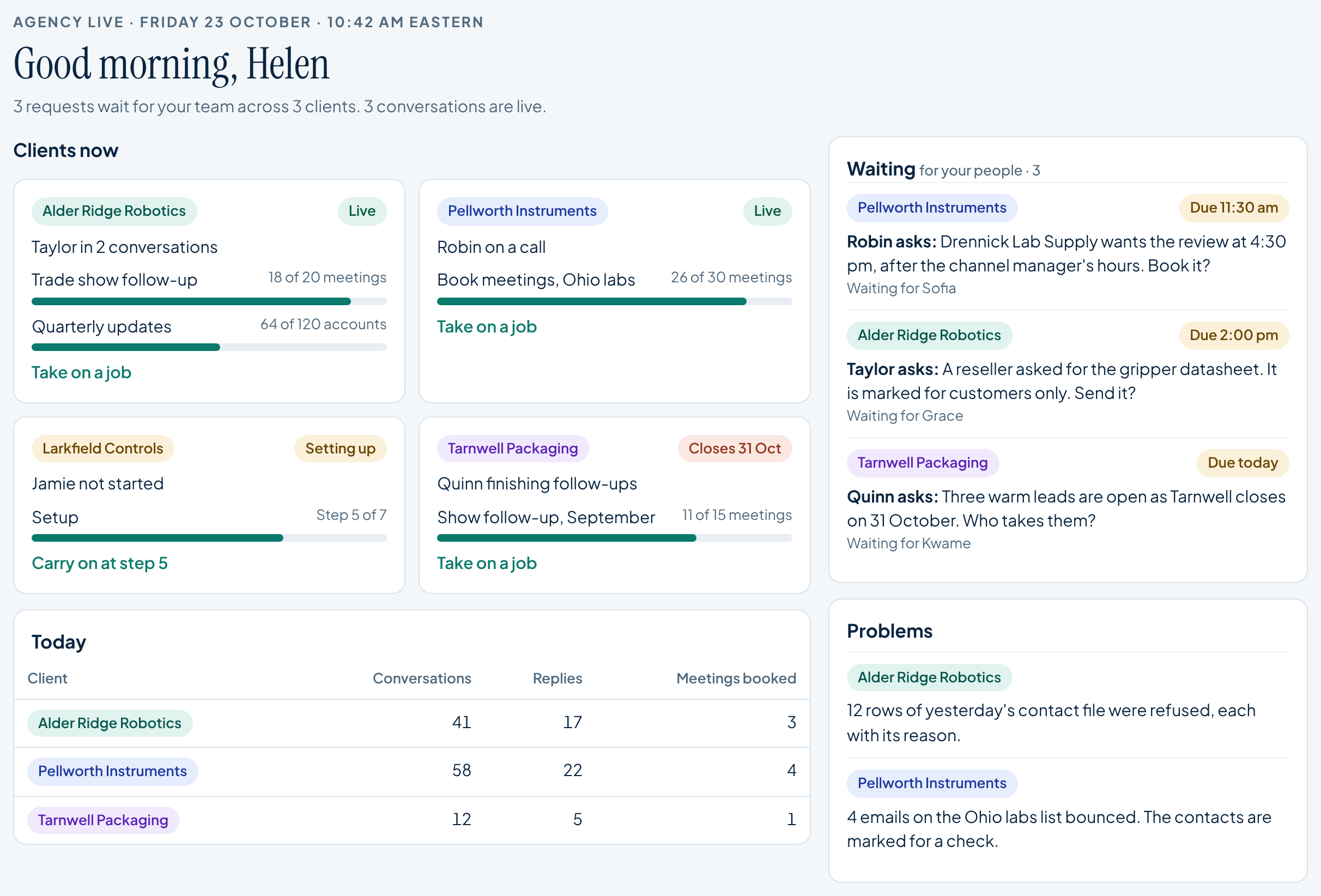
See running jobs, waiting requests and activity across your agency. Keep the context, permissions and decisions with the right client team.
Your delivery model.
Their way of selling.
Reuse an effective playbook where appropriate. Tailor the audience, message, worker assignments and decision owners for each client job.
Client one
Its accounts & knowledge
Its approved playbooks
Its workers & decision owners
Client two
Its accounts & knowledge
Its approved playbooks
Its workers & decision owners
Client three
Its accounts & knowledge
Its approved playbooks
Its workers & decision owners
Illustrative configuration. Client memory, permissions and connected systems remain separate.
Explore agency desks and workersFrom client brief
to a clear next step.
Give each job a purpose, an owner and a way to see how the work is progressing.
Agree the job.
Set the client objective, audience, approved offer and contact basis. Decide which questions or commitments need a person.
Build the client team.
Assign virtual workers and human owners. Configure the playbook, allowed channels, capacity and country controls.
Run and review.
Follow activity and usage by client, job and campaign. Route replies and decisions to the right agency or client person.
Build the service once.
Shape it for every client.
Reusable offerings and agency playbooks give each engagement a starting point. Tailor objectives, materials, rules and reporting for the client, then set the audience, message, people and pace for each job.
- Choose the offeringThe service, playbook and expected outcomes.
- Configure the clientIts knowledge, connections, limits and decision owners.
- Agree the jobTargets, price and client sign-off or an existing approval.
- Practise and deliverTry the workflow before live customer contact.
One desk. The right client.
Requests, messages and meetings are labelled with their client. Opening an item brings the desk into that client’s context. Calls and replies use the configured client identity.
A price and a report for each job.
Set a fixed, per-outcome or included price. Track usage and progress by client, job and campaign. Review the client report, keeping reported outcomes distinct from results confirmed by its systems.
Repeat the setup, not the admin.
Reuse file mappings and loading rules. Review rejected rows with their reasons. Clients stay on their chosen offering version until you test and move them.
Keep delivery accountable.
Listen, guide, join or take over where permitted. Stop one client’s workers independently. Approve lessons before use, and export the client’s records when the engagement closes.
Reuse your agency’s offerings and playbooks. Each client’s records, research, memory and recordings stay separate.
Explore the campaign delivery workflowBring your next
client brief.
Explore how your agency could deliver it with a team of virtual workers.