Epistemic Drift & Reasoning Validity

When agents act on a version of reality that no longer exists.

The Problem

Standard monitoring detects data drift and model drift. But agentic systems face a subtler failure mode: epistemic drift, where the agent's internal model of reality gradually diverges from actual reality. This happens because:

Epistemic drift is particularly dangerous because the agent continues to function normally by every standard metric. It simply acts on a version of reality that no longer exists.
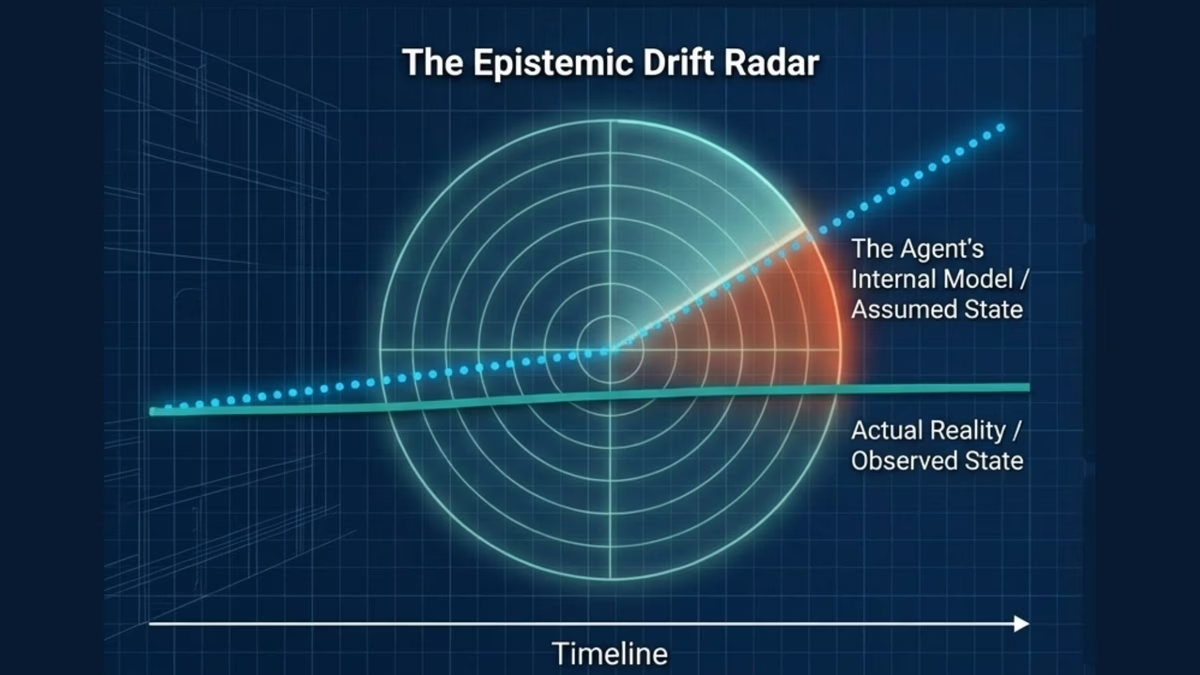
Three Faces of Epistemic Drift

Temporal Validity Drift

Context that was momentarily accurate but decays. A customer profile retrieved at 09:00 may not reflect a significant transaction at 13:00. Market data from 15 minutes ago may not reflect a flash crash. The data was correct when retrieved — it is simply no longer current.

Causal Dependency Drift

Assumptions about causal relationships that shift. Revenue growth has historically correlated with repayment ability — until a recession changes the relationship. An agent reasoning from the historical correlation continues to produce confident outputs based on a causal model that no longer holds.

Assumption Obsolescence

Deployment baselines that become invalid. A system migration changes network topology. A regulatory update changes compliance thresholds. A vendor change alters API behaviour. The agent's foundational assumptions were valid at deployment but have been overtaken by events.

Why Standard Monitoring Misses It

Standard AI monitoring watches for data drift (distribution changes) and model drift (performance degradation). These are necessary but insufficient for agentic systems.

A model can maintain 94% accuracy on stale inputs. An agent can execute logically flawless reasoning on premises that are factually stale, manipulated, or incomplete.

The distinction is between “the model is performing correctly” and “the inputs are wrong.”

Decision Validity Warrants

The solution is a Decision Validity Warrant — a structured, inspectable record documenting:

Decision Validity Warrants are distinct from confidence scores. A confidence score tells you the model is 94% confident. A validity warrant tells you whether the foundation of that confidence is sound.

Causal Dependency Mapping

Making assumptions testable and monitorable requires explicit validity conditions. Temporal validity windows define how long specific types of context remain reliable:

When a validity window expires, dependent reasoning is flagged for re-evaluation. This transforms epistemic drift from an invisible failure mode into a measurable, governable property of the system.

Go Deeper

Our Agentic AI Workshop covers epistemic drift detection and reasoning assurance in depth.