A trace per conversation. A cost per interaction. A budget that acts.
This is the layer that makes a fleet of virtual workers operable rather than experimental, and it is the layer most often retrofitted. Retrofitting is expensive: telemetry added after the fact never covers the paths that turn out to be interesting, and entitlement added after the fact is unenforceable because the code already assumes everything is permitted. The Hub emits a structured trace and a cost record from the first conversation it handles.
Span levellatency captured per step, not per call
Per interactioncost attributed along every dimension
Never silentlimits warn, act and raise an event
Telemetry
A conversation is a trace, not a log line.
Context assembly, each turn, each tool call, each skill invocation, retrieval, write back and evaluation, with latency captured per span. That is what makes a voice worker debuggable at all. When a call feels slow, the answer is almost never "the model" and almost always one specific span.
Dimension group
Captured on every interaction
Identity
Tenant, worker, the worker definition version, and the version of each of the six prompt layers actually in force
Configuration
The engine bindings actually used, being model and thinking level per task class, voice provider and voice, and any fallback that was triggered
Context
Scenario, engagement goal, channel, language spoken, record language, jurisdiction, capture level, and the account and contact under the required pseudonymisation
Conduct
Turn count, duration, talk and listen ratio, interruptions, tools called, skills invoked, retrievals issued, escalations and requests raised
Result
Outcome level and status, score, typed findings, cue recall where simulated, transaction outcomes, write backs performed
Cost
Every priced unit consumed, attributed to the task class that consumed it
monitoring
Operations asks: is it working?
Voice first token latency, turn latency at median and tail, tool error rates, channel delivery failures, degradation events, queue depth, concurrency against capacity.
payments
Finance asks: what did it cost?
Per interaction cost attributed along every dimension, and the ratios that matter commercially rather than raw token counts.
lightbulb
Product asks: what next?
Which failure classes dominate, which simulation cells are weak, which knowledge gaps recur, which requests are raised most often.
link
A correlation identifier threads from the originating event through the flow, the conversation, the outcome contract and the system of record write back, so a booked meeting traces back to its trigger and a bad write back traces forward from the turn that caused it. Telemetry and audit stay separate systems: audit is immutable and compliance scoped, telemetry is operational and carries identifiers and measures, never conversation content.
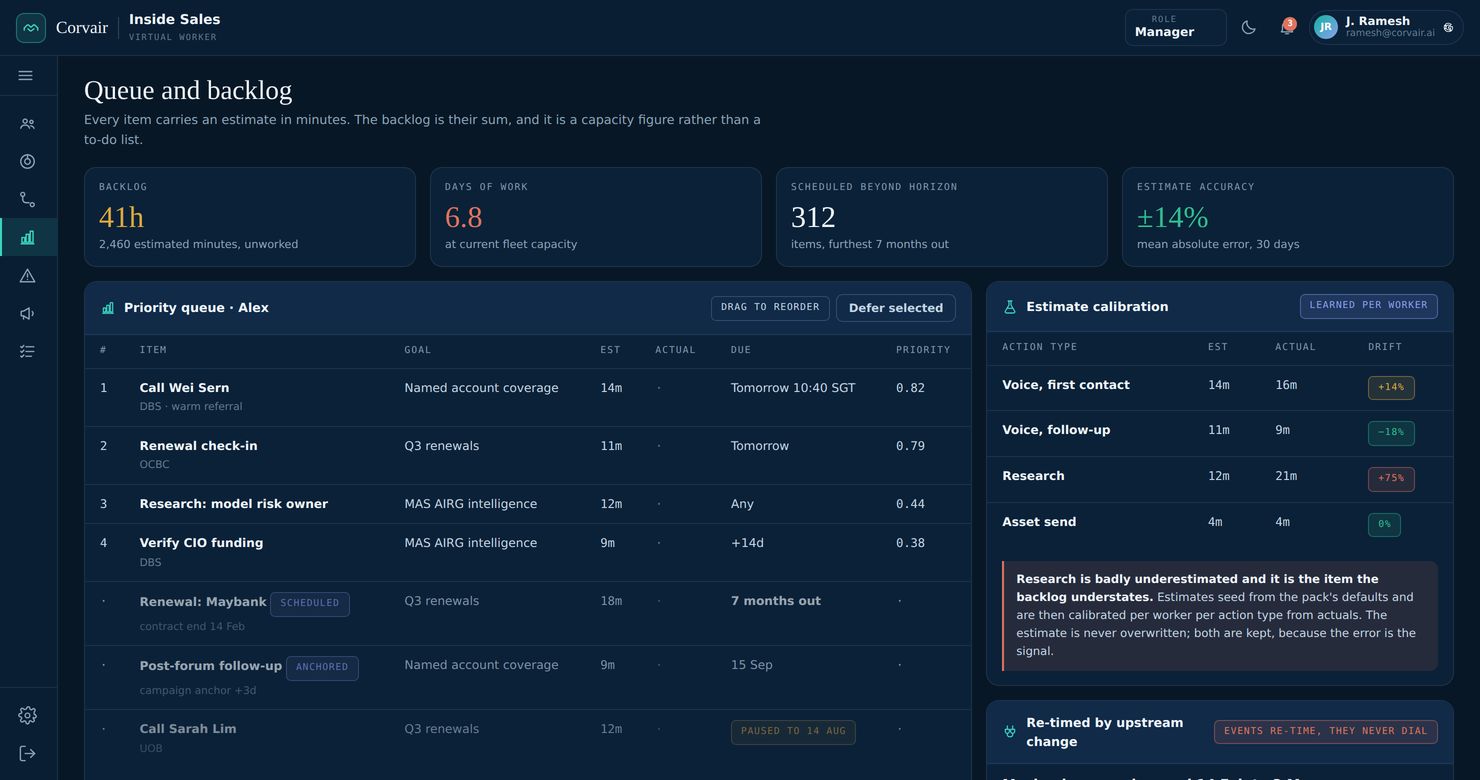
The backlog, sized in minutes and read against your cycle. Every item carries an estimate that calibrates to the individual worker from actuals. Forty-one hours means nothing; forty-one hours against a five day cycle is a coverage miss you can already prove.
Cost capture
A conversation with a known price.
Cost is captured per interaction and attributed along every telemetry dimension, so one record answers what a worker, a channel, a language, a scenario or a campaign costs.
Cost class
Notes
Live conversation tokens
Audio dominates by a wide margin, which has a design consequence worth stating
Voice engine time
Per provider, which is one of the axes on which two providers actually get compared
Carriage
Telephony minutes and messaging fees, per channel and per destination
Deliberative model calls
Analysis, coaching, research and extraction. Individually large, but bounded and predictable per conversation
Retrieval and embedding
Knowledge queries during and after a conversation
Storage
The sleeper cost. Retained audio at scale, in many languages, under a long retention period
Simulation
The mass suite has a real price, and it is visible before a run rather than after
A worker that talks less is both better and cheaper. The rule requiring one short sentence per turn exists because it makes the worker sound like a competent colleague. It also happens to be the single largest cost lever in the system, so conversation design and unit economics point the same way.
forum
Cost per conversation, by worker, channel, language and scenario
event_available
Cost per booked meeting or completed conversion, which is the number that matters
trending_up
Cost per qualified opportunity, traced through to the system of record
badge
Projected cost per worker per month, so a buyer can hold it against a salary
savings
Budgets act, they do not merely report. Ceilings at tenant, worker and campaign level, with a soft threshold that warns and a hard threshold that does something configured: degrade to a cheaper binding, queue non urgent work, or stop and escalate. The one prohibited behaviour is silent failure. And a live conversation is never terminated by a budget: quota is evaluated when a conversation starts, never mid turn, because hanging up on a prospect to save tokens is worse than any overspend it prevents.
Entitlements, limits and caps
What you bought, enforced where it matters.
Entitlement is a commercial statement. Limits are the technical enforcement. Keeping them distinct is what stops a sales concession from requiring a deployment.
Dimension
Typical shape
Workers
Which worker packs are licensed, and how many instances may be active at once
Channels
Which are enabled, since telephony and messaging carry both cost and compliance weight
Languages
Which of the supported set are enabled for your tenant
Engine tiers
Whether the deliberative and elevated thinking tiers are available, or only standard bindings
Knowledge and assets
Number and size of knowledge bases, asset volume, retention periods
Recording
Whether audio capture is available at all, and for how long recordings are retained
Simulation
Mass runs per period, and whether the voice tier is included
Transactions
Whether transactional capability is enabled, and the value ceiling that applies
Seats
How many users of each role, which is how the coach and the studio are packaged
Interface rate
API and MCP call rates, and concurrency
Enforced at two points, never one
The control plane refuses configuration that exceeds entitlement, so you cannot enable a channel you have not bought and the option is visibly unavailable rather than failing later. The runtime enforces consumption limits, being rate, concurrency and spend, at the point of use.
Behaviour at a limit follows the same principle as budget: warn before the ceiling, act at it in a configured way, name the limit and the remedy in language an operator can act on, and raise it as a system event.
Capped pilots are a first class shape
A pilot is an entitlement configuration: a few workers, one channel, one language, a fixed simulation allowance, a spend ceiling and a time bound. Making that a configuration rather than a manual arrangement is what lets a pilot be provisioned in a day and converted without a rebuild.
Metering is the same record that feeds cost capture, deliberately. A usage based model requires a meter you can audit, and a meter that disagrees with the cost attribution is worse than no meter at all. One record, two readings.
The control plane
Workers are supervised, and the supervisor may be a worker.
The layer that defines, configures, assigns and supervises workers is kept separate from the data plane in which conversation happens, because the two have different availability requirements. A control plane outage must never take a live call down.
Which workers exist, which are active, which people each serves, and which accounts, territories, languages and channels each covers.
speed
Capacity and pacing
Daily volumes, calling windows, concurrency and spend ceilings, all adjustable without a release.
Supervisory responsibility
Human manager
Virtual manager
Monitor score distributions and flag drift
Reviews dashboards on a cadence
Continuous, alerts on threshold breach
Triage the failure ledger
Judgement on ambiguous cases
Classifies and clusters recurring signatures
Approve prompt revisions
Holds the authority
May propose only. Approval stays with a named person
Reallocate objectives and priorities
Strategic judgement
Within pre-approved bounds only
Handle escalations from workers
Owns the outcome
Routes and prepares context. Never resolves a compliance escalation
Coach individual workers
Reviews sampled conversations
Runs the calibration loop and surfaces the exceptions
gpp_maybe
What makes a virtual supervisor safe is that its authority is a strict subset, and the boundary is explicit. It may observe, classify, cluster, prioritise, propose and reallocate within bounds. It may not approve changes to a kernel or client prompt layer, alter compliance configuration, expand its own authority, or resolve an escalation that reached it because a guardrail was approached. The practical case for it is simple: the calibration loop generates far more signal than a human manager can read, and a virtual manager is the filter that turns thousands of scored conversations into the dozen decisions a person should actually make this week.
The request board
The worker asks for what it does not have.
When a worker reaches a moment it cannot serve, such as a contact asking for a case study in a vertical that has none, the correct behaviour is neither to improvise nor to fail silently. It is to tell the contact honestly that it will follow up, log the gap, and raise a request.
Raised
New requests, with the conversation, contact and account attached as context.
Triaged
Classified, prioritised and owned. Priority follows how many conversations are blocked on the same gap.
In progress
Being produced, by a person or by another virtual worker.
In review
Awaiting approval before entering the asset library or the knowledge base.
Available
Published. The requesting worker is notified and a proactive event fires to every relevant contact.
Declined
With a reason, which is itself intelligence. A repeatedly declined request is a strategy question.
The board also carries the calibration queue of proposed prompt edits and the escalation queue, so everything needing a human decision about the worker fleet lives in one place. Two properties make it more than a task list: requests carry their originating context, so whoever picks one up sees the actual conversation that needed it, and an available asset closes the loop backwards, because the contact whose question could not be answered becomes a queued proactive touchpoint the moment it is published.
Next
See how it is packaged and priced.
A platform licence, workers as the unit of value, domain content on subscription, and usage passed through with a meter you can audit.