It has to feel like the application, not like a chatbot bolted to one.
Run the inside sales worker and you are in a sales application. Run the property worker and you are in a property system. Same engine, same screens, different product.
That is not a theme. The worker pack carries an application profile: the name of the application, the vocabulary, the navigation for each role, and the iconography. The runtime renders from that profile rather than from labels hardcoded by us. Account becomes Property. Contact becomes Buyer, Vendor, Applicant, Landlord or Tenant, five counterparties rather than one. Meeting becomes Viewing.
A lexicon that carries a lifecycle does not flatten it. Where the person changes name as they move through the funnel, the lexicon says so. Mapping everyone to their end-state term has the worker greeting an enquirer as though the relationship already existed.
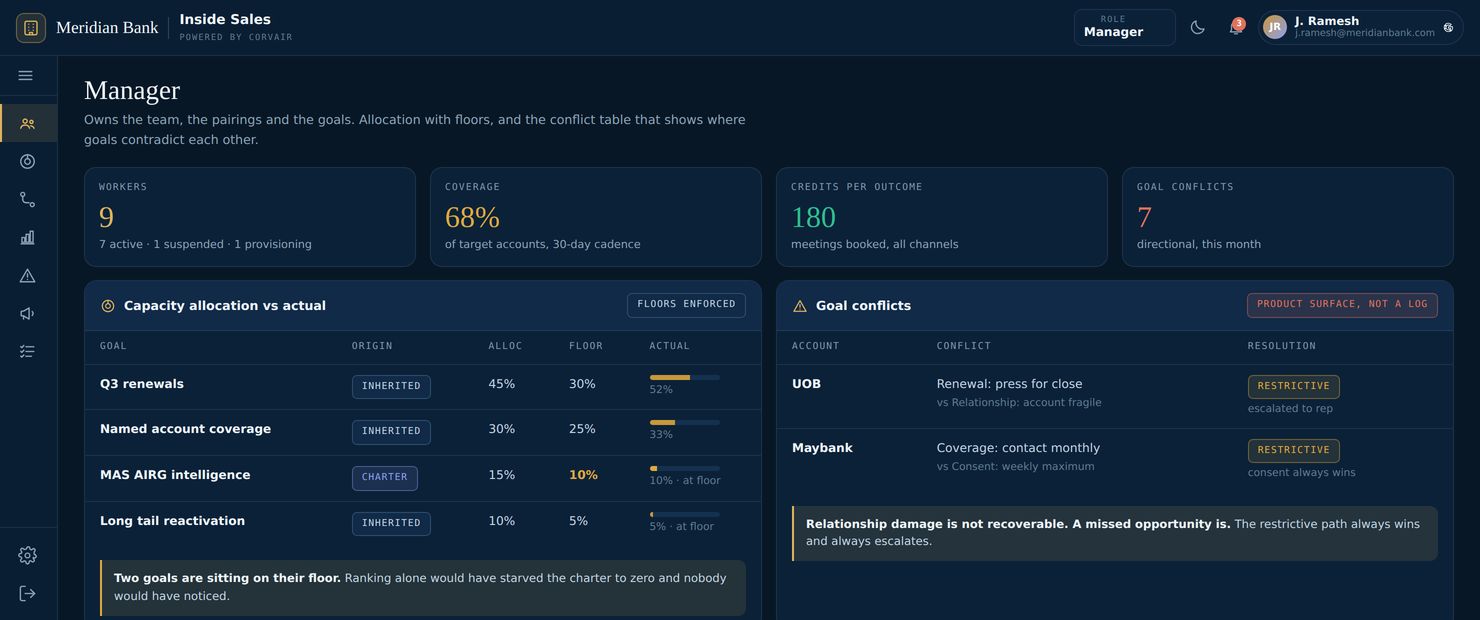
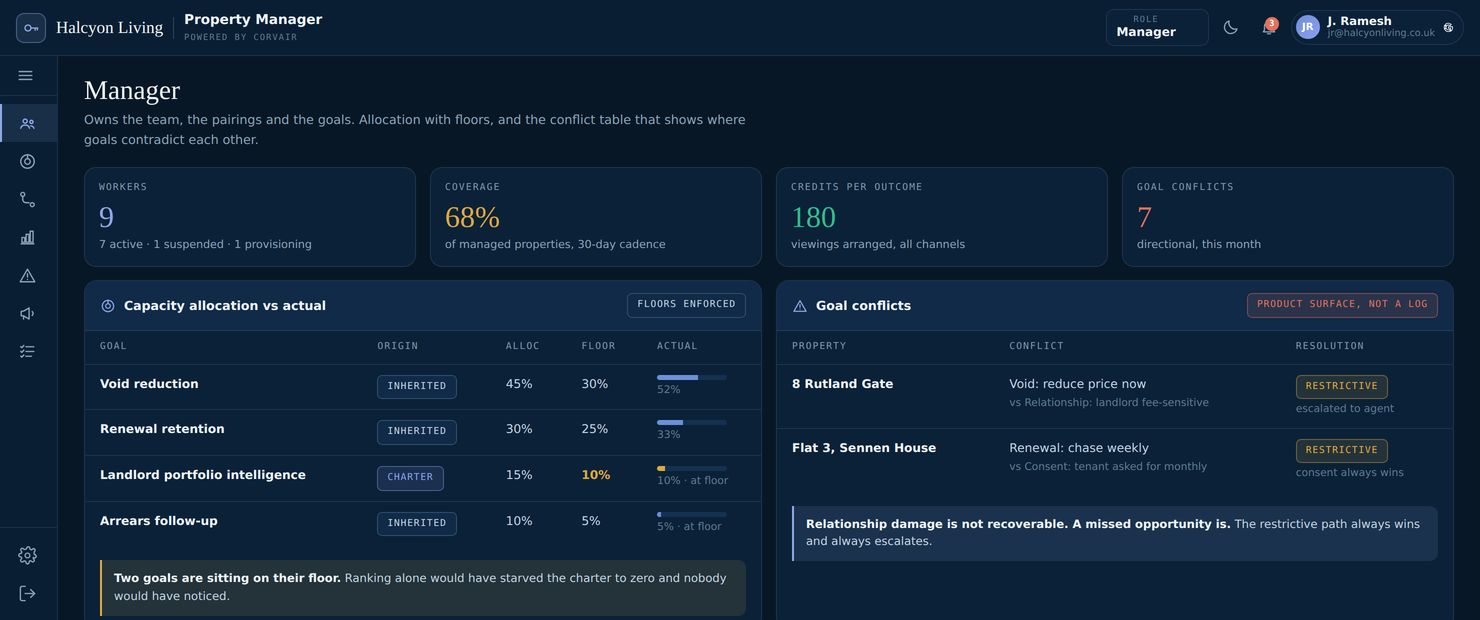
Neither picture is a translation of the other. The ladders end somewhere different: a meeting with the CIO in one, a viewing confirmed or a market appraisal booked in the other. The outcome contracts capture different fields, and property declares five of them where inside sales declares one. Even the worst failure the calibration loop guards against is different: offering a callback into resistance in one, and in the other, giving a figure on the phone.
The property worker does not value and it does not price. Not a figure, not a range, not a guide, not a number qualified into safety. A figure given on the phone becomes the number every later conversation is measured against, so refusing turns into the reason to book the appointment, which was the outcome the call wanted. The appraisal appointment is the outcome, and it scores full marks.
A tenant may extend the vocabulary but not replace it. Adding a term the pack does not define is configuration. Redefining one it does define breaks every measure bound to it and every future upgrade, so the editor refuses rather than warns.
Your own brand sits on top and is preserved across upgrades: your name, your mark, your accent colour, your outbound identity. The profile belongs to the pack; the branding belongs to you.
What actually changes between workers.
| Worker | Primary ladder | Systems of record | Domain content |
|---|---|---|---|
| Inside Sales Assistant | Executive meeting, then stakeholder meeting, then account team follow up | CRM, calendar, workspace | Sales methodology, product and competitive knowledge |
| Property Assistant | Five contracts. Viewing confirmed for a buyer or an applicant, market appraisal booked for a vendor, landlord decision confirmed, renewal agreed for a tenant | Instruction record, listing platform, enquiry and viewing workflow | Local market playbook, instruction and transaction knowledge |
| Domain Coach | Skill gap identified, then rehearsal completed, then measurable improvement | The Hub's own evidence base, plus CRM | Methodology library, objection handling, conversation examples |
| Customer Success | Renewal secured, then conversation scheduled, then escalation routed | CRM, entitlement and usage systems, service desk | Product, entitlement and support knowledge |
| Marketing | Asset published, then draft in review, then brief clarified | Asset library, brand system | Brand, positioning and content knowledge |
| Relationship Assistant | Review meeting, then adviser follow up, then information pack | Core banking, portfolio and CRM systems | Licensed wealth management content |
| Collections & Workout | Arrangement agreed, then hardship review, then specialist referral | Servicing and collections platform | Regulatory and hardship handling content |
| Fleet Manager | Drift detected, then cluster triaged, then revision proposed | The Hub itself | Scoring rubrics and calibration policy |