Three patent-pending inventions and a comprehensive knowledge portfolio, purpose-built for governing autonomous AI agents in regulated industries.
Corvair holds three patent applications filed in Singapore in 2025, each addressing a distinct gap in how organisations govern autonomous AI systems. Together they cover the full lifecycle: how agents reason, how their premises are validated, and how their authority is controlled.
When an AI system makes a consequential decision, current approaches provide no way to inspect which perspectives were considered, which trade-offs were made, or whether mandatory constraints were respected. Corvair's Cognitive Substrate Architecture system makes AI reasoning transparent by decomposing it into inspectable units that debate, critique, and refine each other, with every step recorded in an auditable trail.
Learn more arrow_forwardAn AI agent can be statistically confident in a conclusion built on premises that are no longer true. Markets shift, data goes stale, regulations change. Corvair's Cognitive Causality Architecture continuously validates the inputs and assumptions behind every decision, producing a cryptographically signed Validity Warrant that documents exactly what was true at the moment each decision was made.
Learn more arrow_forwardTraditional identity and access management was built for humans with static permissions. Autonomous AI agents accumulate authority through delegation chains, operate across environments they were not designed for, and drift from their declared purpose. Corvair's Unified Governance system measures and controls the total potential impact of every agent across its entire lifecycle, from registration through active operation to retirement.
Learn more arrow_forwardBeyond the patent applications, Corvair maintains a comprehensive body of original research, risk analysis, and regulatory intelligence that underpins our advisory practice.
133 agentic AI risks across 15 categories, scored on the DAMAGE framework (Detectability, Autonomy Sensitivity, Multiplicative Potential, Attack Surface, Governance Gap, Enterprise Impact).
Explore risks arrow_forward28 regulatory guides across 10+ jurisdictions with a coverage matrix mapping risks to frameworks. MAS AIRG, EU AI Act, NIST, ISO 42001, and more.
Browse guides arrow_forward234 scored agentic AI use cases across BFSI, Corporate Finance, Healthcare, and HR. Each scored for governance complexity and risk.
View use cases arrow_forwardCorvair operates an independent, crowdsourced research programme studying how AI is reshaping professional work. Six original assessments, built on dual-condition methodology, produce 111 professional archetypes across dimensions of vulnerability, adoption, friction, enablement, risk calibration, and data readiness. Participation is free, anonymous, and open to all knowledge workers.
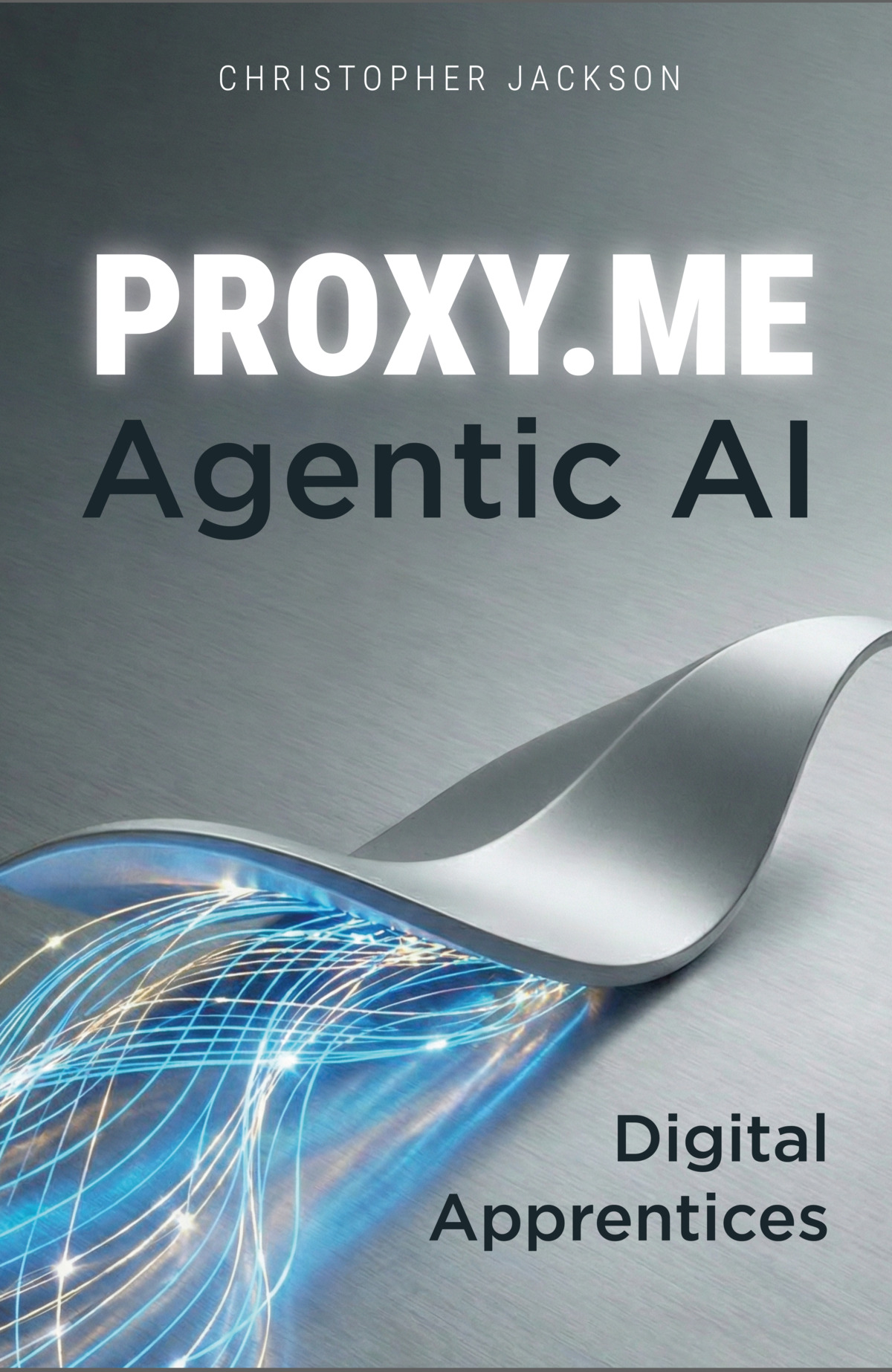
Proxy.Me: Agentic AI Digital Apprentices by Christopher Jackson (May 2026).
Today's AI coding assistants and open-source agents operate as isolated tools: single-channel, stateless, ungoverned, and disconnected from the enterprise. A digital apprentice is fundamentally different. It is an AI agent that functions as a genuine professional understudy: communicating across channels including voice, coordinating with other agents through mesh networking, operating under built-in governance with full auditability, and enforcing zero standing privileges by design.
This is not a technical manual. It is a business book for knowledge workers and the leaders responsible for them, explaining how the current generation of digital assistants will evolve into governed digital apprentices, and what organisations need to do now to be ready for that transition.
menu_bookLearn MoreSchedule a complimentary briefing to learn how Corvair's patent-backed methodology applies to your institution's AI governance requirements.
Schedule a Briefing Contact Us