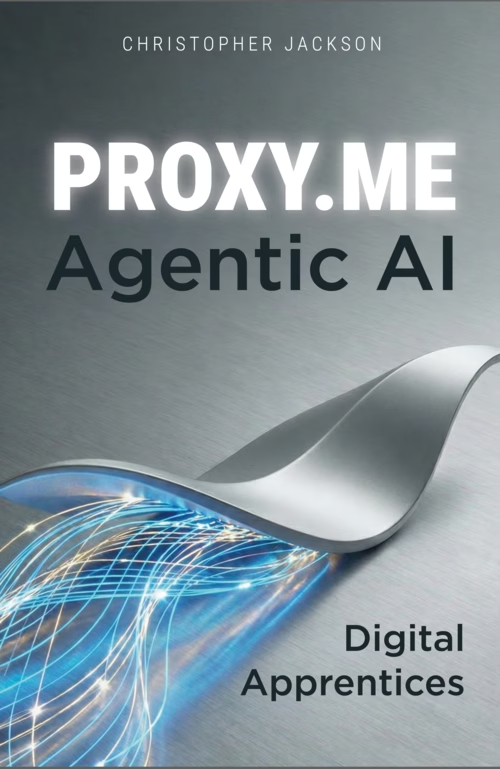
Media Kit
Proxy.Me
Agentic AI Digital Apprentices
By Christopher Jackson. Print and e-book July 10, 2026. Audiobook, read by the author, later in 2026.
Media Kit
Agentic AI Digital Apprentices
By Christopher Jackson. Print and e-book July 10, 2026. Audiobook, read by the author, later in 2026.
Pre-baked angles for journalists. Each gives you a pitch, why it lands now, what Chris can speak to specifically, and the venues we think it fits. Mix and match across pieces; Chris can speak to any combination.
The AI Productivity Trap: why your individuals are faster but your organisation isn't.
Why now: Two years into enterprise AI rollouts, executives are asking why the productivity numbers don't show up at the P&L line. The book argues the answer is structural: AI accelerates tasks but doesn't change the coordination cost between them.
Chris can speak to: the diagnostic playbook that distinguishes activity from momentum, why local productivity gains rarely scale, and what changes in the operating model are needed to convert AI velocity into enterprise velocity.
Best for: HBR-style business publications, CFO/CIO trade press, McKinsey Quarterly-equivalent
Will AI take my job? The fear is automation. The reality is that most of your day is the coordination tax around the work, not the work itself.
Why now: Public anxiety about AI is at its peak just as the first persistent agents reach the desktop. The book reframes the conversation: a Proxy carries the coordination, not the judgment, so people get back the time they never wanted to spend on tracking, status, and re-explaining.
Chris can speak to: augmentation versus automation, the categories of work that compress under AI versus the categories that don't, and what knowledge workers should do this year to stay ahead.
Best for: general business press, opinion pages, future-of-work podcasts, mainstream tech
What comes after today's desktop AI assistants and copilots.
Why now: Today's desktop and chat agents are the front edge of something bigger. The book maps the trajectory from assistant to understudy to apprentice, and from individual tool to mesh-coordinated system.
Chris can speak to: what current agents do well, where they hit a wall, what persistence and memory change about the governance problem, and how desktop agents will quietly become the building blocks of enterprise Proxies.
Best for: technology press, AI publications, developer-focused outlets, tech podcasts
Six Sigma for AI: applying lean manufacturing discipline to make AI agents reliable.
Why now: The reliability conversation around AI is dominated by safety and bias. The book imports Toyota's poka-yoke and the seven Muda from manufacturing and translates them into AI governance vocabulary, including five new categories of "kinetic waste" specific to fleets of agents.
Chris can speak to: Lean Six Sigma for AI quality, defect-rate measurement on agentic systems, error-proofing through veto lenses, and why this discipline is missing from current AI deployments.
Best for: operations/quality publications, manufacturing trade press, ASQ-adjacent outlets, industrial podcasts
Mesh networks of AI agents: how machine-to-machine coordination changes enterprise architecture.
Why now: Agent-to-agent protocols (Google A2A, MCP, and emerging mesh standards) are arriving faster than the governance to contain them. The book introduces the Work Graph, mesh topologies, and cumulative operational authority as the framework architects need before, not after, deployment.
Chris can speak to: mesh design patterns, identity propagation across agents, the difference between a workflow and a Work Graph, and what enterprise security models miss about persistent multi-agent systems.
Best for: enterprise architecture publications, CIO/CTO outlets, security trade press, technical podcasts
Governance you can replay: making AI decisions auditable by design, not after the fact.
Why now: MAS AIRG, EU AI Act, and SR 11-7 are all moving toward continuous auditability for AI systems that act with consequence. The book proposes attestation chains, the Work Graph, and replayable evidence as architectural answers to what regulators are starting to demand.
Chris can speak to: the regulatory convergence on AI auditability, why traditional model-card and policy approaches fall short for persistent agents, and the shift from documenting governance to designing it in.
Best for: regulatory trade press, GRC/compliance publications, banking technology outlets, policy-focused media
From individual augmentation to organisational lift: why the next AI buyers are operating leaders, not heads of innovation.
Why now: The CIO bought the AI tools. The COO is now responsible for explaining why the throughput hasn't shifted. The book reframes AI from a tool-procurement question to an operating-model question, and gives operating leaders the language to lead it.
Chris can speak to: the operating-model implications of agentic AI, the difference between Roles and job descriptions, and what changes in resource allocation, performance management, and team structure when Proxies are part of the operating system.
Best for: CFO/COO publications, operating-leader podcasts, leadership development outlets
When HR becomes architectural: the post-transformation role of People functions in an apprenticeship economy.
Why now: If a Proxy is bound to a Role rather than a person, HR's traditional definitions of headcount, performance, and succession all need updating. The book includes a full chapter on what that shift looks like for CHROs.
Chris can speak to: the People-Role-Proxy triad, performance management when judgment lives in the Role, succession planning when continuity is no longer carried by the individual, and the architectural rather than administrative future of HR.
Best for: HR Executive, SHRM, HR Brew, talent leadership podcasts, leadership development press
Founder's story: from 11 years at Teradata to writing the book on what comes after the AI assistant.
Why now: The shift from Field CTO at one of the world's largest enterprise data companies to founding a patent-backed governance firm in Singapore tracks the broader move from data infrastructure to AI accountability. The book is the cumulative argument from that career arc.
Chris can speak to: the personal trajectory that led to the book, the regulatory environment in Asia versus the West, why he chose Singapore, and what the founding period of an advisory firm in this space looks like from the inside.
Best for: founder profiles, Asian business press, entrepreneurship outlets, Singapore-specific media, long-form podcasts
mailPitches, exclusive excerpts, advance review copies, and interview scheduling: media@corvair.ai. Typical response within one business day.
Five approved lengths for listings, previews, newsletters, and show notes. Pick a length and copy; the text is identical across retailers and platforms.
"AI reduces the cost of creation but increases the cost of coherence."Chapter 4
"In a refinery, operators do not carry barrels; they regulate flow. In the Kinetic Organization, leaders do not carry the work; they ensure the work carries itself."Chapter 5
"Judgment establishes direction. Continuity creates motion."Chapter 10
"Structure describes intention. Flow reveals truth."Chapter 13
"It feels like the system is carrying us instead of us carrying it."Chapter 14
"The Kinetic Organization is not a metaphor for working faster. It is a blueprint for staying human inside complexity."Chapter 25
"Abundant intelligence does not create an advantage. Judgment does."Epilogue

Author, Founder & CEO, Corvair
Christopher Jackson brings 35+ years at the intersection of enterprise data, analytics, and AI. He spent 11 years at Teradata, including roles as Director of Platform Architecture and Field CTO for Global Emerging Markets and APJ, working with banks, insurers, telecoms, and public-sector institutions across Asia and the Middle East.
He founded Corvair Pte Ltd in Singapore as a patent-backed AI governance advisory firm. Three patent applications cover novel approaches to agent governance, reasoning validity, and composable auditable reasoning. He is a graduate of the NUS Chief Strategy Officer programme. He is an American citizen based in Singapore, and writes from direct experience designing systems that must work under real operational pressure, not from theory.
Proxy.Me: Agentic AI Digital Apprentices is his first book. He narrates the audiobook edition.
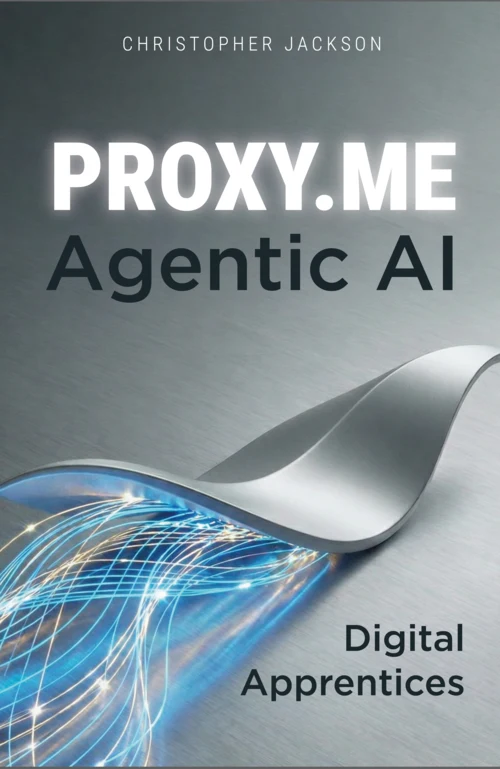
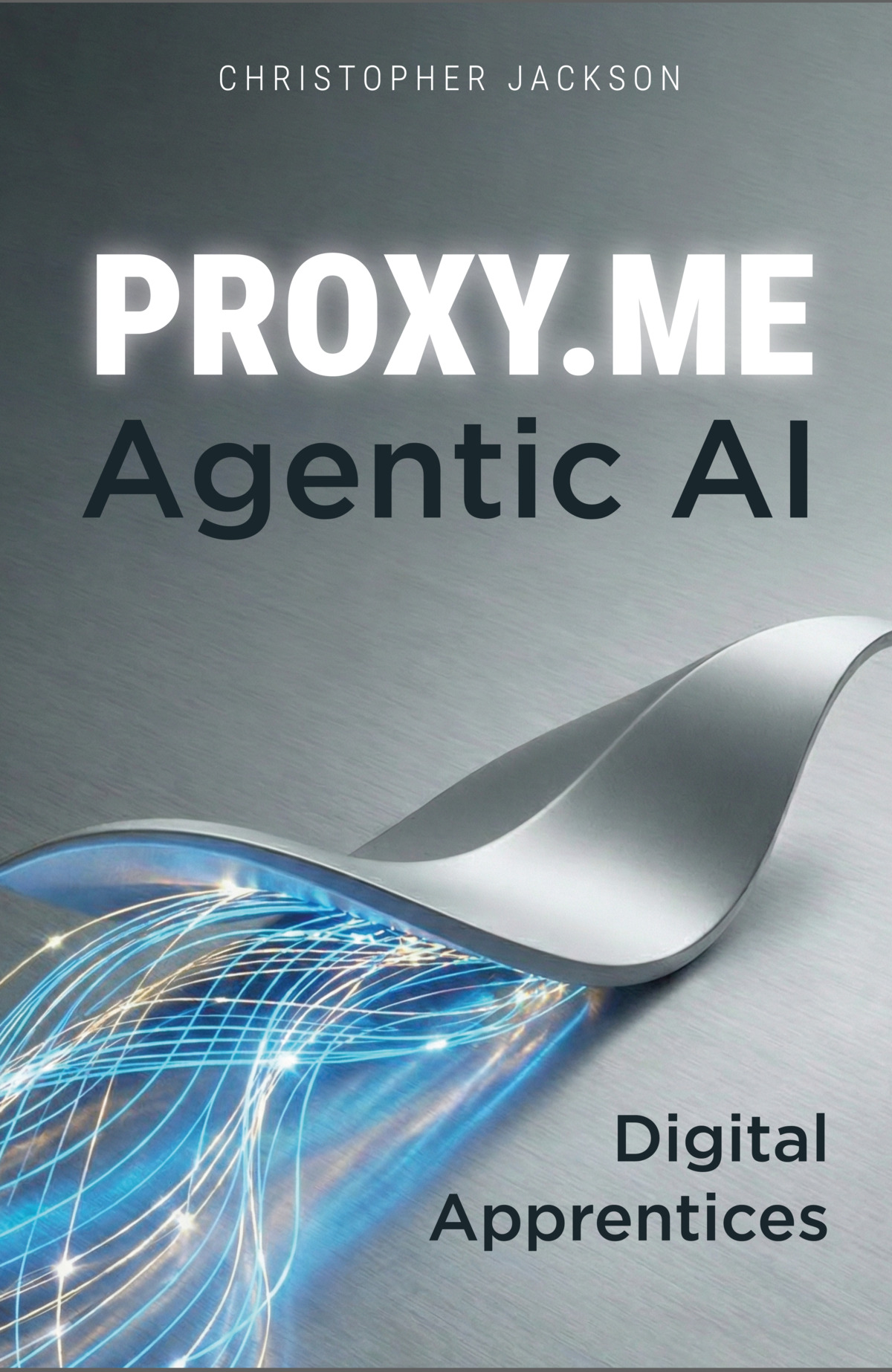
Alternate cover treatments and additional brand assets available on request to media@corvair.ai.
Christopher Jackson is available for interviews, podcasts, excerpts, and commentary on agentic AI in regulated enterprises. Based in Singapore; comfortable across US, European, and APAC time zones.
Prefer email directly? media@corvair.ai
For media inquiries, request an interview with Christopher Jackson above. For business briefings, schedule a complimentary 60-minute session.
Request an Interview Schedule a Briefing