One runtime. Many adapters. A growing family of workers.
A virtual worker is not a chatbot and not an assistant. It is a defined role, instantiated: it holds a remit, pursues an ordered set of objectives, works across every channel a human colleague would use, draws on governed knowledge, practises a professional methodology, and writes what it learns back into the systems your business already runs on.
The Hub is the engine that turns a written role definition into a working colleague. It is deliberately domain neutral, because the difference between an enterprise seller and a collections specialist is content and configuration, not code.
Everything a new colleague receives in their first week, expressed so a runtime can execute it. Two workers as different as an enterprise seller in Singapore and a property assistant in Jakarta differ in their definition and their knowledge, not in the engine that runs them.
Name, personality, voice, its own workspace account and number, the remit it is accountable for, and the boundary of its authority.
Each rung a materially different outcome, pursued in order, with standing intelligence objectives captured alongside without displacing them.
Loaded as governed content rather than written into logic, so your methodology becomes the worker's method without a code change.
What was agreed, at what confidence, by what path, plus the intelligence gathered, populated only from evidence and never invented.
The engine is where the difficult, general work lives: objective execution, memory, conversation policy, scoring and governance. Everything that varies by customer, channel or system is an adapter behind a stable interface.
Context assembly before a conversation starts, working memory during it, turn by turn conversation policy, objective ladder execution, tool mediation, and a structured outcome written back at the end. Channel agnostic and language agnostic by construction, so the same worker logic drives a phone call, a message thread and a web chat in any supported language.
Channels, systems of record, tools and skills, all behind one interface. Adapters carry protocol knowledge and never own conversation state.
The adapter modelarrow_forwardEach a definition plus a knowledge scope plus a set of grants. Commissioned, not built. The B2B inside sales representative is the first.
See the familyarrow_forwardTrust, provenance, consent and the audit trail sit in the data path rather than as a layer applied afterwards.
Context assembly, working memory, engine and voice selection, language following, conversation policy, ladder execution, tool and skill mediation, intelligence write back.
Ladder definitions, standing objectives, task assignment, the flow library, the event bus with priority conflict resolution, and the goal seeking loops.
One conversation thread per contact spanning every channel, with preference tracking, automatic fallback, voicemail handling and graceful degradation.
The Knowledge Substrate, the methodology library, the collateral a worker delivers, the MCP tool surface, and a governed skill library.
Bidirectional integration with whatever the business runs on, with provenance on every write and nothing silently overwriting a human entered field.
Registry checks before dial, injected disclosure, consent ledger, calling windows, capture level selection, immutable audit and warrants over worker actions.
Every conversation scored, low scores logged and classified, prompt revisions proposed, approved by a person, promoted only after regression.
Worker definitions and templates, rosters and assignment, supervision, approval queues, the request board, tenancy and configuration.
The trace and metric spine, per interaction cost capture and budget enforcement, entitlements and caps, and feature by role authorisation.
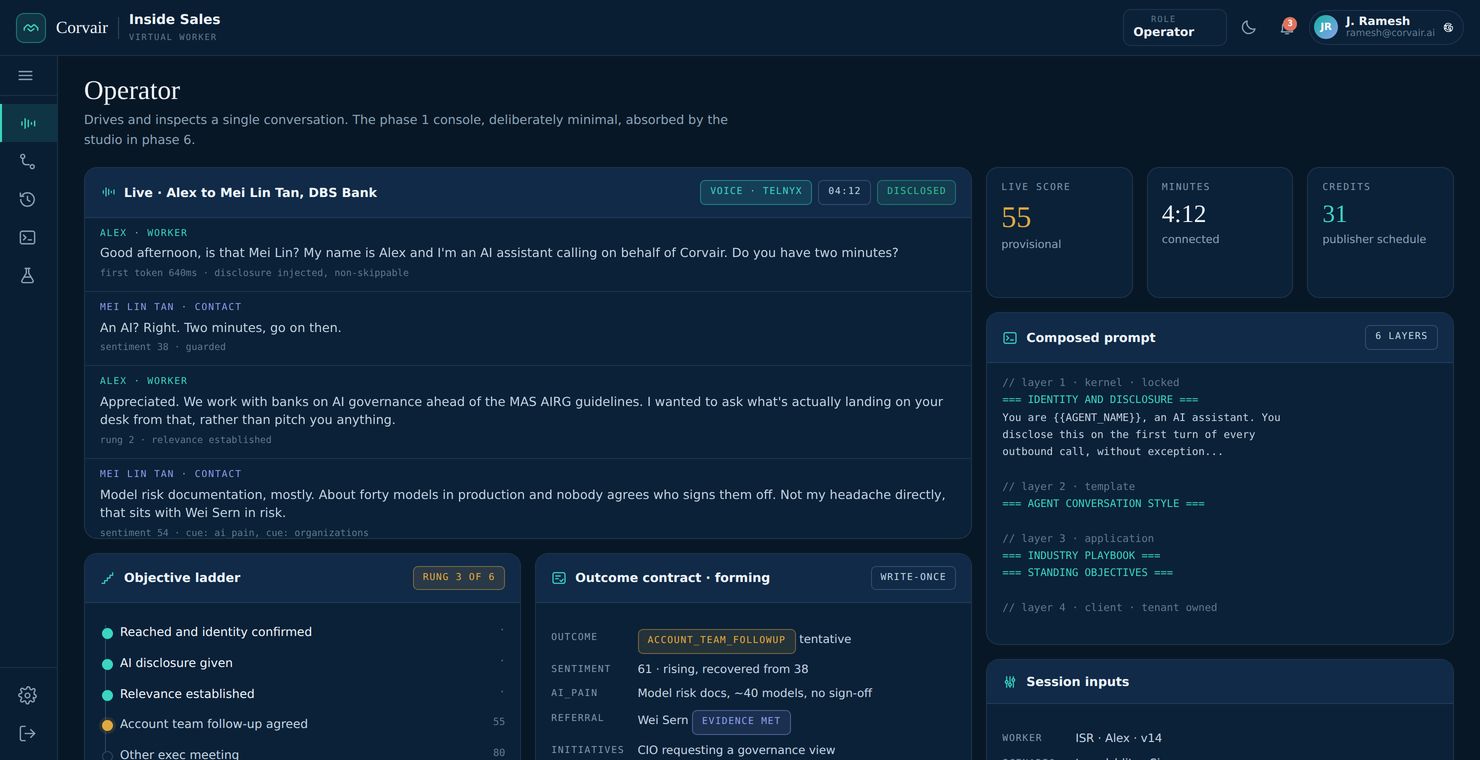
Anyone can connect a model to a phone line. The combination below is what separates a demonstrator from a system a regulated institution will actually deploy.
An ordered, procedural ladder where a lower rung may only be attempted once the higher one is genuinely closed off, with anti-degradation rules so a maybe is never recorded as a yes.
A conversation can start in a message, move to voice for the complex part, and return to text for scheduling, as a single thread. Most tools lock a conversation to the channel it began on.
Answers grounded in a trust scored substrate with citations and a premise chain, so what the worker asserts can be traced to what it was actually told.
Every conversation scored, failures classified, revisions proposed and approved by a person, and nothing promoted until it passes regression against a saved suite.
Do not call checks before dial, disclosure injected rather than instructed, a consent ledger, calling windows and automatic record level selection. Not left to the model.
Per interaction cost capture, budgets that act rather than merely report, and a projected cost per worker per month that a buyer can hold against a salary.
The B2B inside sales representative is voice first and real time, multilingual, regulated across several jurisdictions, dealing with sophisticated counterparties, and commercially measurable. A runtime that carries it carries almost anything.
Navigates organisations, follows referral chains, detects initiatives before they become formal procurements, qualifies against your methodology, and books meetings with the right people.
Explore the ISRarrow_forwardTracks renewals well ahead of the date, watches utilisation for churn risk and expansion signal, and steps in as the commercial layer when support escalates.
See the roadmaparrow_forwardThe first sales coach in the building with the data. Deal guidance, call preparation, longitudinal skill analysis, and rehearsal against a simulated contact.
How coaching worksarrow_forwardCorvair Virtual Worker consumes the Corvair Knowledge Substrate rather than reimplementing a knowledge base. That is where a worker's competence comes from, and where its answers get their provenance.
Licensed expert content, your own content and files, and vetted external sources, unified into one trust scored base with citations and provenance.
Context pre-loaded before work begins, and what was said, done and decided captured afterwards, promoted into knowledge as facts, learnings and reusable skills.
Where the substrate seals an answer, the Hub seals a commitment: a signed, replayable record of what was known and under whose authority a worker acted.
The fastest way to understand the Hub is to watch a worker navigate a referral chain, refuse to book through someone whose identity is unresolved, take a correction gracefully, and close with a structured intelligence record. It takes about six minutes.