Corvair.ai is a Singapore-based AI product company for institutions that answer to a regulator. We build the governed knowledge and reasoning layer, provide the advisory practice around it, and publish the research the field relies on, so every AI decision is grounded, attributed, and defensible. Built for banking, insurance, and the public sector, and sound enough for any organisation that takes AI seriously.
People make consequential decisions every day without recording what they rest on: which facts, which sources, and whose authority. AI agents are now being deployed to make and support those same decisions at scale, usually with even less of a trail. And regulators are moving in one direction: they will expect more, not less, and are already looking for the controls, the security, and the provable basis behind every automated decision.
The Knowledge Substrate: a governed knowledge and reasoning layer with a Validity Warrant on every answer.
See the productarrow_forwardReadiness, governance framework design, and a Center of Excellence to stand it up and adopt it.
See servicesarrow_forwardThe Agentic AI Risk Catalog, the Regulations Guidebook, the coverage matrix, and the book, Proxy.Me.
Explore the researcharrow_forwardThe software that gives regulated institutions trustworthy knowledge and governed reasoning, so every AI answer and decision is grounded, attributed, and provable.
A governed knowledge layer and virtual expert for regulated industries. It unifies licensed expertise, your own content, and vetted sources into one trust-scored base, keeps it current with cooperating agents, and answers in plain language with a citation and a signed Validity Warrant behind every word, for people and AI agents alike.
People and AI agents reach the same governed base the same way, with the same attribution and the same proof behind every response.
Turn practical ideas into documented inventions through idea refinement and prior-art research. Explore how your expertise can become a useful intellectual property asset.


Convenience without proof is a liability in a regulated decision. Corvair makes the governance explicit: what the base covers, which sources a claim rests on, whether it is current, and who or what decided, all signed and replayable.
A signed Validity Warrant records the knowledge, reasoning, and authority behind every answer. Open it months later and it still verifies.
Every source carries a tier, and the tier travels into every answer, so trust is governable rather than a feeling.
People and AI agents share one governed surface under a scoped authority, with circuit breakers and a full audit trail.
Built on original research, Lean Six Sigma measurement, and decades of enterprise architecture in regulated industries.

The substrate works for any knowledge-intensive domain. We ship the Banking Suite first, prebuilt virtual experts for six front-office domains on one governed substrate, and any other domain, including government, is built from your own content, a recipe rather than a new deployment.

Six front-office domains, one substrate. See the full suite and the virtual experts.
See the suitearrow_forwardRelationship managers, advisors, and planners on a governed wealth base.
Explorearrow_forwardModel risk, prudential, and AI governance for a regulated lender.
Explorearrow_forwardSovereign, auditable AI for agencies and regulators: decisions grounded in policy and law, and provable to a public standard of accountability.
How it worksarrow_forwardProduct-led, service-supported. Installation, adoption, customization, and custom agents get your Knowledge Substrate live; advisory and implementation services bring the governance and the Center of Excellence around it.
Installation and configuration, adoption, customization, custom agents, and a Data & AI Center of Excellence.
Servicesarrow_forwardRole-based training and certification so every role uses the substrate well and safely.
Trainingarrow_forwardAIRG readiness, governance framework design, and a Center of Excellence from our advisory practice.
Advisoryarrow_forwardA working body of agentic-AI risks, regulations, and use cases, used by governance teams in regulated industries and the public sector.
133 agentic-AI risks across 15 categories, scored on the DAMAGE framework and mapped to 13 regulatory frameworks.
Readarrow_forward28 jurisdiction and framework guides: EU AI Act, MAS AIRG, GDPR, NIST AI RMF, SR 11-7, DORA, PIPL, and more.
Readarrow_forwardSee exactly which risks each framework governs, at a glance, across all 13 mapped frameworks.
Open the matrixarrow_forward200+ scored agentic-AI use cases across BFSI, corporate finance, healthcare, and HR.
Browsearrow_forwardOriginal research into how ungoverned agentic AI goes wrong. The Knowledge Substrate is designed to close each one.

An agent's real permissions are emergent and dynamic, not declared.
Read the conceptarrow_forward
When agents reason correctly on premises that are no longer true.
Read the conceptarrow_forward
Most knowledge work is coordination overhead that governed agents structurally reduce.
Read the conceptarrow_forward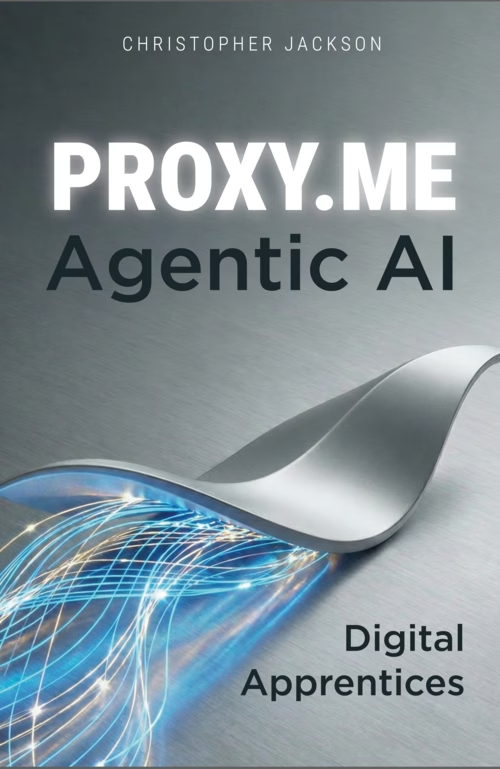
Proxy.Me explains why, and shows how digital apprentices move from assistants to understudies that carry the work. Always on, always learning, always helpful, and fully governed. From Corvair founder Christopher Jackson.
Founded by practitioners in enterprise architecture and AI governance, and backed by an original research programme. Corvair founder Christopher Jackson is the author of Proxy.Me and is available for keynotes and workshops on agentic-AI governance.
Book a briefing to see Corvair on your own knowledge, or reach the right desk directly.
The Proxy.Me launch note and the introduction chapter, plus the occasional research finding. No noise.